
Pocket Refractometers
Small, Robust and Faster than Ever—Our Digital Pocket Refractometers Deliver Accurate Results in Just Two Seconds
A pocket refractometer is a small handheld device that measures the refractive index of liquids. It works by analyzing the angle of refraction of light that interacts with samples, providing an accurate measurement of the refractive index. Our digital pocket refractometers are ergonomically designed and provide results within two seconds at the touch of a button. Its compact and lightweight construction makes it effortless to carry in your pocket, so you can take measurements anywhere.
Advantages of METTLER TOLEDO's Pocket Refractometers

Ready for All Samples
Our refractometers master a wide variety of applications, including refractive index, Brix, and other sugar content or concentrations.

Measure Anywhere
Engineered with high-quality components to ensure a long lifespan, our digital handheld refractometers can withstand harsh environments on the go, in the production area, or in a quality control lab.

Say Farewell to Your Analog Refractometer
Compared with analog refractometers, digital refractometers provide more reliable results, eliminate operator dependency, and assist in detecting errors.
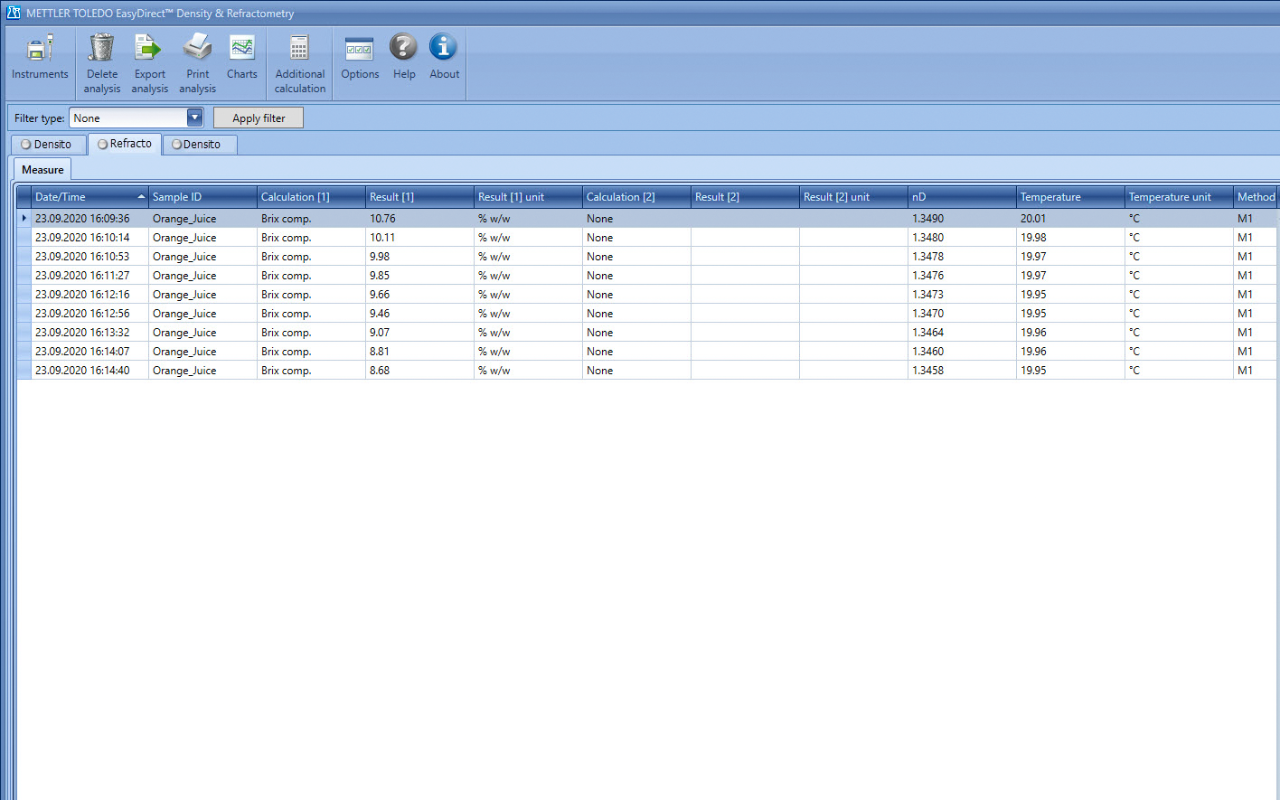
Advanced Data Storage
The handheld digital refractometer line, Refracto, stores up to 1,100 results and connects to EasyDirect PC software for enhanced data viewing.
Useful Related Links

Sugar Analysis on the Go
The MyBrix refractometer is compact, robust and weatherproof. Receive immediate results wherever you are—in the field, near the production line or in a quality control lab. Read more

Sugar Determination with the MyBrix Pocket Refractometer
MyBrix comes with a full Brix range and 10 integrated sugar-related scales including refractive index, Brix, °Baumé, Oechsle, °Plato, and Wort—perfect for measuring almost any food and drink sample! Read more

Guides, Application Notes, White Papers, and More!
Find expert information to improve your results, save time, and stay on top of norms and regulations. You'll find everything from short and useful tips to comprehensive guides and webinars. Read more

Refracto for Precise Results Anywhere
The handheld digital refractometer line, Refracto, can be used on a flat surface or dipped directly into the sample for quick and simple measurements. Read more

Brix Measurement
Brix measurement is a simple yet accurate way to determine the concentration of sugar/sucrose in a solution. Learn more about brix measurement now. Read more
Explore Our Services - Tailored to Fit Your Equipment
We support and service your measurement equipment through its entire life-cycle, from installation to preventive maintenance and calibration to equipment repair.
Support & Repair


Training & Consulting

- Automotive Refractometers
- Cooling Lubricant Hand Refractometers
- Digital Coolant Refractometers
- Digital Handheld Refractometers
- Digital Refractometers
- Hand Refractometer
- Oechsle Scale Refractometers
- Pharmaceutical Laboratory Refractometers
- Plato Refractometers
- Portable Refractometers for Milk
- Refractive Index Device
- Refractometers for Antifreeze
- Refractometers for Beer
- Refractometers for Coffee
- Refractometers for Edible Oils and Fats
- Refractometers for Fruit
- Refractometers for Glycol Analysis
- Refractometers for Honey
- Refractometers for Sugar
- Refractometers for the Laboratory
- Refractometers for Urine
- Refractometers for Wine
- Standard EasyPlus Refractometers
- Wort Refractometers
FAQs
How do you use a pocket refractometer?
Using a digital pocket refractometer is as simple as ever. Almost anyone can use one by following these three simple steps.
Firstly, make sure the prism is clean. Secondly, add a few drops of sample to the prism—approximately 0.3 ml—ensuring it is well covered. Finally, press the button to begin measuring. You'll receive the results in just two seconds.
All our pocket refractometers deliver results that are automatically temperature compensated and converted into up to three of the 10 integrated sugar-related scales, including Brix, Oechsle, °Baumé, and many more. You can easily toggle through these on the device until you find the number that represents your desired scale.
How do you calibrate a pocket refractometer?
The calibration of a digital pocket refractometer is very simple. In this video, you will find out how to calibrate and verify a METTLER TOLEDO MyBrix pocket refractometer quickly and easily. All you need to get started is your MyBrix refractometer, a small amount of pure water, and some lint-free tissue paper.
Additionally, you will learn how to get reliable results and perform trustworthy analyses.
Watch the video below to learn more:
What are the uses of a pocket refractometer?
Due to their portability, high accuracy, and ease of use, digital pocket refractometers are used across several industries to measure the refractive index of many different substances.
In the food and beverage industry, for example, pocket refractometers are widely employed in production and quality control applications to determine the sugar content (Brix) of fruit juices, carbonated beverages, beer, honey, jams, confectionaries, and much more. To determine the optimal harvesting time, winemakers also rely on pocket refractometers to measure the Oechsle of grape must in vineyards. While it is not as common, you may also find them being used when brewing coffee to measure the TDS (Total Dissolved Solids)—which is a good indicator of how well the coffee is extracted.
In the chemical industry, pocket refractometers are typically used to verify the concentration value of acids, bases, or the presence of organic solvents in inorganic salt (% w/w or v/v). Meanwhile, in the pharmaceutical industry, a they are employed to control the purity and concentration of raw materials, semi-finished products, and end products during manufacturing.