Advantages of METTLER TOLEDO's Digital Handheld Refractometers

Ready for All Samples
Our refractometers master a wide variety of applications, including refractive index, Brix, and other sugar content or concentrations.

Measure Anywhere
Engineered with high-quality components to ensure a long lifespan, our digital handheld refractometers can withstand harsh environments on the go, in the production area, or in a quality control lab.

Say Farewell to Your Analog Refractometer
Compared with analog refractometers, digital refractometers provide more reliable results, eliminate operator dependency, and assist in detecting errors.
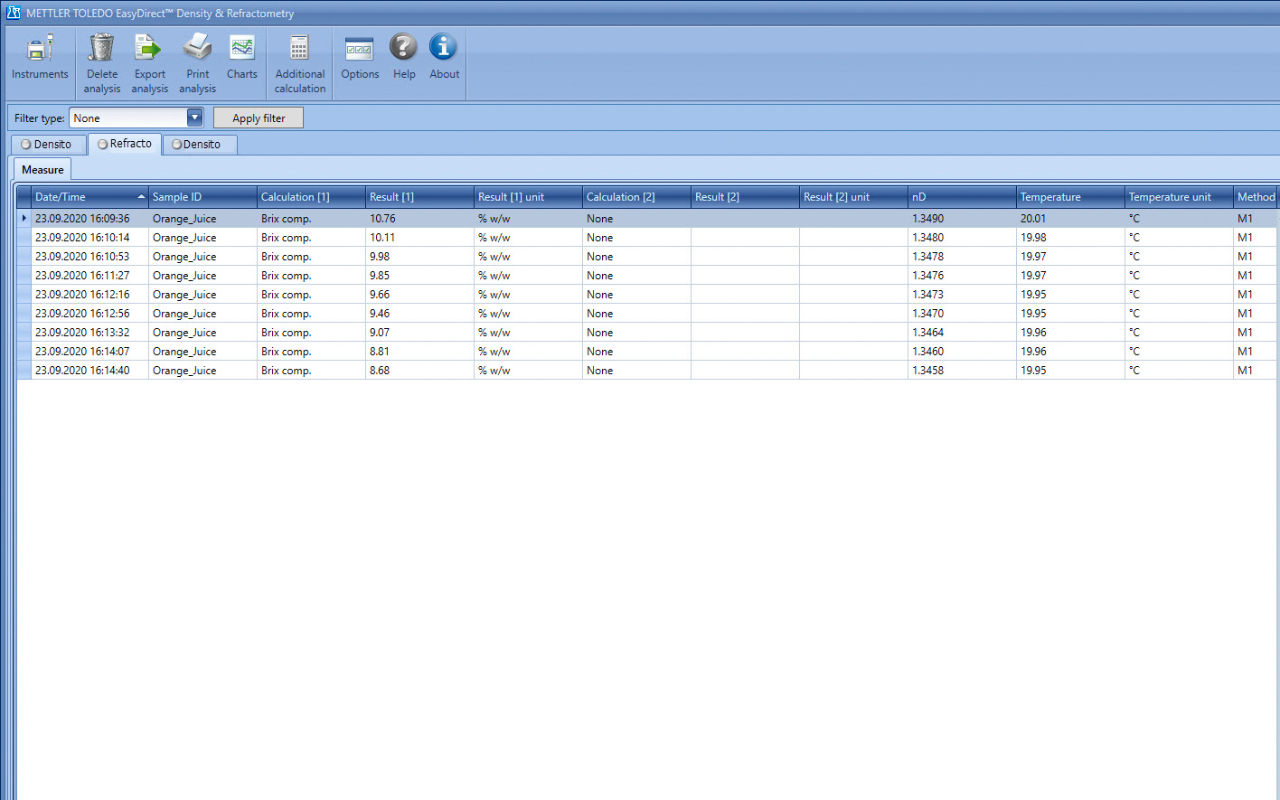
Advanced Data Storage
The handheld digital refractometer line, Refracto, stores up to 1,100 results and connects to EasyDirect PC software for enhanced data viewing.
Useful Related Links

Sugar Analysis on the Go
The MyBrix refractometer is compact, robust and weatherproof. Receive immediate results wherever you are—in the field, near the production line or in a quality control lab.

Sugar Determination with the MyBrix Pocket Refractometer
MyBrix comes with a full Brix range and 10 integrated sugar-related scales including refractive index, Brix, °Baumé, Oechsle, °Plato, and Wort—perfect for measuring almost any food and drink sample!

Guides, Application Notes, White Papers, and More!
Find expert information to improve your results, save time, and stay on top of norms and regulations. You'll find everything from short and useful tips to comprehensive guides and webinars.

Refracto for Precise Results Anywhere
The handheld digital refractometer line, Refracto, can be used on a flat surface or dipped directly into the sample for quick and simple measurements.

Brix Measurement
Brix measurement is a simple yet accurate way to determine the concentration of sugar/sucrose in a solution. Learn more about brix measurement now.
Unlock Service Excellence - Maximize Your Efficiency

Uptime. Support & Repair
FAQs
What are the different types of handheld refractometers?
What are the applications of a digital handheld refractometer?
- Automotive Refractometers
- Cooling Lubricant Hand Refractometers
- Digital Coolant Refractometers
- Digital Refractometers
- Hand Refractometer
- Oechsle Scale Refractometers
- Pharmaceutical Laboratory Refractometers
- Plato Refractometers
- Pocket Refractometers
- Portable Refractometers for Milk
- Refractive Index Device
- Refractometers for Antifreeze
- Refractometers for Beer
- Refractometers for Coffee
- Refractometers for Edible Oils and Fats
- Refractometers for Fruit
- Refractometers for Glycol Analysis
- Refractometers for Honey
- Refractometers for Sugar
- Refractometers for the Laboratory
- Refractometers for Urine
- Refractometers for Wine
- Standard EasyPlus Refractometers
- Wort Refractometers