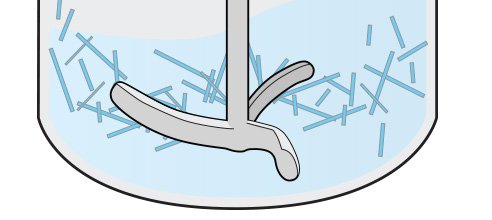
Guide to Crystallization Development

Avoiding Sampling and Offline Analysis
Obtaining a Representative Sample
Offline analysis is commonly used to determine crystal distribution at the end of an experiment or during a production run. While such an approach is common, there are limitations to offline analysis which are relevant for crystals:
- Crystals are delicate and change with temperature – making representative sampling and analysis particularly difficult
- Many crystal systems are toxic and do not lend themselves well to sampling
- It is difficult to take enough offline samples to determine how a fast changing process, such as crystallization, behaves with respect to time.
- The time delay between sampling and offline analysis is often too long, especially in production, to make relevant decisions that can improve product quality

Why Crystal Size and Shape Are Important
Improve the Product and Process
This set of ParticleView images neatly illustrates the complex size, shape, and structure of various crystals. From large round “boulders” to beautifully delicate “dendrites”, crystal product is often varied, posing challenges to effective separation and downstream manipulation.
- The crystals in Image A will likely filter quickly and consistently. The larger boulders will leave plenty of space for the filtrate to pass through rapidly.
- Flat plates like these in Image B can be some of the most difficult to filter. Plates tend to stack on top of each other creating a layer of crystals that the filtrate cannot get through. This leads to long and potentially variable filtration times, depending on how the crystals are discharged from the crystallizer.
- Image C illustrates another case where filtration times can be long. Small crystals will plug the gaps left by the larger crystals making it difficult for the filtrate to pass through the bed of crystals. This is a common problem because many crystallization processes are designed with a fast cool or anti-solvent addition step at the end of the crystallization (to increase yield) that leads to excessive secondary nucleation. Additionally, in many cases the agitation is increased at the end of the batch to help with discharge and this leads to crystal breakage.
- Image D is more common than many would expect, at least in organic crystallization systems that are seeded. A structure such as this would be difficult to observe using an offline microscope as it will be crushed during sampling and preparation. However, ParticleView reveals a beautiful dendritic structure. A dendrite such as this often forms when crystallization is seeded with milled seed. Imperfections on the crystal surface lead to crystal growth from these areas and long crystal branches growing from a seed core. It is difficult to predict how something like this will filter, but it is likely to break apart resulting in variable filtration times.
Real-Time Microscopy
By studying crystals in real time, scientists can develop detailed and reliable process understanding on a routine basis. ParticleView V19 with PVM technology allows scientists to directly observe crystals and crystal structures in process without having to take a sample.
Crystallization mechanisms such as nucleation, growth, breakage, and shape changes can be observed under dynamic changing process conditions and the most suitable process parameters can be chosen with confidence. A simple image-based trend that indicates how crystal size, shape, and count complements high resolution real time images and allows important process events to be identified and investigated immediately.

In-Process Particle Characterization
ParticleTrack with FBRM technology tracks the rate and degree of change to crystals and crystal structures as they naturally exist in process. A precise measurement, sensitive to changing crystal size, shape, and count, is provided in real time under dynamic changing process conditions at full process concentrations. This technique is applied as a standard tool during crystallization development and is a powerful process monitoring instrument in production, where it is used to troubleshoot difficult processes and ensure batch-to-batch consistency.
Using ParticleTrack, scientists can:
- Study crystal count in individual size classes – to optimize fine and coarse ends of the crystal size distribution
- Identify the root cause of a poorly performing crystallization process
- Choose the correct process parameters for optimal crystallization performance using process-based evidence
- Monitor processes for repeatability and consistency
- Correlate in-process measurements to offline particle size analysis
- Model the influence of crystal size and count on product and process quality

Focused Beam Reflectance Measurement (FBRM)
Inline Particle Size, Count, and Shape
A ParticleTrack probe with FBRM technology is immersed into a flowing slurry or droplet system with no dilution necessary. A focused laser scans the surface of the probe window and tracks individual chord lengths - measurements of particle size, shape, and count. This real-time measurement is presented as a distribution and statistics (eg. mean, counts) are trended over time.

Technologies To Measure Crystal Size
Crystallization unit operations offer the unique opportunity to target and control an optimized crystal size and shape distribution. Doing so can dramatically reduce filtration and drying times, avoid storage, transport, and shelf life issues, and ensure a consistent and repeatable process at a lower cost.
Guide to Effective Process Development
This white paper series covers basic and advanced strategies to optimize crystal size and shape distribution.

Use Image Analysis To Optimize Crystallization
Discover how image-based process trending can reduce crystallization cycle time and improve quality while maintaining a similar crystal size and shape.

Seeding a Crystallization Process
This white paper discusses best practices for designing a seeding strategy and what parameters should be considered when implementing a seeding protocol. Although crystallization understanding has improved over the last thirty years, the seeding step still presents challenges.
Các Ứng dụng
Particle Size, Shape, and Count Measurement To Improve Crystallization


Supersaturation Control Optimizes Crystal Size and Shape
Crystallization kinetics are characterized in terms of two dominant processes, nucleation kinetics and growth kinetics, occurring during crystallization from solution. Nucleation kinetics describe the rate of formation of a stable nuclei. Growth kinetics define the rate at which a stable nuclei grows to a macroscopic crystal. Advanced techniques offer temperature control to modify supersaturation and crystal size and shape.

Giám sát thời gian thực phục vụ Mô hình hóa và Kiểm soát
Kết tinh liên tục trở nên khả thi nhờ những tiến bộ trong mô hình hóa quy trình và thiết kế thiết bị kết tinh, vốn tận dụng khả năng kiểm soát phân bố kích thước tinh thể trong thời gian thực thông qua việc giám sát trực tiếp quần thể tinh thể.

How Solvent Addition Can Control Crystal Size and Count
In an antisolvent crystallization, the solvent addition rate, addition location and mixing impact local supersaturation in a vessel or pipeline. Scientists and engineers modify crystal size and count by adjusting antisolvent addition protocols and the level of supersaturation.

Tạo độ siêu bão hòa và Xác định sản phẩm tinh thể cuối cùng
Một quy trình kết tinh theo mẻ được thiết kế tốt là quy trình có thể chuyển đổi quy mô thành công sang sản xuất thực tế — mang lại phân bố kích thước tinh thể, hiệu suất, dạng tinh thể và độ tinh khiết mong muốn. Việc tối ưu hóa kết tinh theo mẻ đòi hỏi phải duy trì sự kiểm soát thỏa đáng đối với nhiệt độ của thiết bị kết tinh (hoặc thành phần dung môi).

The Building Blocks of Crystallization
Solubility curves are commonly used to illustrate the relationship between solubility, temperature, and solvent type. By plotting temperature vs. solubility, scientists can create the framework needed to develop the desired crystallization process. Once an appropriate solvent is chosen, the solubility curve becomes a critical tool for the development of an effective crystallization process.

Recover Lactose with High Yield and Scalable Process
Lactose crystallization is an industrial practice to separate lactose from whey solutions via controlled crystallization.

Tạo Mạng Lưới Có Cấu Trúc, Có Trật Tự Cho Các Đại Phân Tử Phức Tạp
Kết tinh protein là hành động và phương pháp tạo ra các mạng lưới có cấu trúc, có trật tự cho các đại phân tử thường phức tạp.

Thiết kế và tối ưu hóa giao thức gieo hạt để cải thiện tính nhất quán hàng loạt
Giao hạt là một trong những bước quan trọng nhất trong việc tối ưu hóa hành vi kết tinh. Khi thiết kế một chiến lược gieo hạt, các tham số như: kích thước hạt giống, tải hạt giống (khối lượng) và nhiệt độ bổ sung hạt giống phải được xem xét. Các tham số này thường được tối ưu hóa dựa trên động học quá trình và các đặc tính hạt cuối cùng mong muốn và phải duy trì nhất quán trong quá trình mở rộng quy mô và chuyển giao công nghệ.

Detect and Prevent Oiling Out (Liquid-Liquid Phase Separation)
Liquid-Liquid phase separation, or oiling out, is an often difficult to detect particle mechanism that can occur during crystallization processes.

Improve Crystallization with Inline Particle Size, Shape, and Count Measurement
In-process probe-based technologies are applied to track particle size and shape changes at full concentration with no dilution or extraction necessary. By tracking the rate and degree of change to particles and crystals in real time, the correct process parameters for crystallization performance can be optimized.

Mở rộng quy mô khuấy trộn, định lượng, và kết tinh
Thay đổi quy mô hoặc điều kiện pha trộn trong một mát kết tinh có thể trực tiếp ảnh hưởng đến động học của quá trình kết tinh và kích thước tinh thể cuối cùng. Hiệu quả truyền nhiệt và dẫn chất rất quan trọng cần xem xét cho các hệ thống làm lạnh và chống hòa tan tương ứng, trong đó gradien nhiệt độ hoặc nồng độ có thể tạo ra tính không đồng nhất ở mức siêu bão hoà phổ biến

Understand Polymorphism and the Impact of Process Parameters
Crystal polymorphism describes the ability of one chemical compound to crystallize in multiple unit cell configurations, which often show different physical properties.

Lực thúc đẩy cho quá trình kết tinh
Siêu bão hòa xảy ra khi một dung dịch chứa nhiều chất tan hơn mức có thể về mặt nhiệt động học, dựa trên các điều kiện của hệ thống. Siêu bão hòa được xem là yếu tố chính thúc đẩy quá trình kết tinh.

Optimization of Crystal Properties and Process Performance
Recrystallization is a technique used to purify solid compounds by dissolving them in a hot solvent and allowing the solution to cool. During this process, the compound forms pure crystals as the solvent cools, while impurities are excluded. The crystals are then collected, washed, and dried, resulting in a purified solid product. Recrystallization is an essential method for achieving high levels of purity in solid compounds.

Cải thiện các thí nghiệm kết tinh với kiểm soát chính xác
Máy kết tinh MSMPR (Mixed Suspension Mixed Product Removal) là một loại máy kết tinh được sử dụng trong các quy trình công nghiệp để sản xuất tinh thể có độ tinh khiết cao.
Crystallization kinetics are characterized in terms of two dominant processes, nucleation kinetics and growth kinetics, occurring during crystallization from solution. Nucleation kinetics describe the rate of formation of a stable nuclei. Growth kinetics define the rate at which a stable nuclei grows to a macroscopic crystal. Advanced techniques offer temperature control to modify supersaturation and crystal size and shape.
Một quy trình kết tinh theo mẻ được thiết kế tốt là quy trình có thể chuyển đổi quy mô thành công sang sản xuất thực tế — mang lại phân bố kích thước tinh thể, hiệu suất, dạng tinh thể và độ tinh khiết mong muốn. Việc tối ưu hóa kết tinh theo mẻ đòi hỏi phải duy trì sự kiểm soát thỏa đáng đối với nhiệt độ của thiết bị kết tinh (hoặc thành phần dung môi).
Solubility curves are commonly used to illustrate the relationship between solubility, temperature, and solvent type. By plotting temperature vs. solubility, scientists can create the framework needed to develop the desired crystallization process. Once an appropriate solvent is chosen, the solubility curve becomes a critical tool for the development of an effective crystallization process.
Giao hạt là một trong những bước quan trọng nhất trong việc tối ưu hóa hành vi kết tinh. Khi thiết kế một chiến lược gieo hạt, các tham số như: kích thước hạt giống, tải hạt giống (khối lượng) và nhiệt độ bổ sung hạt giống phải được xem xét. Các tham số này thường được tối ưu hóa dựa trên động học quá trình và các đặc tính hạt cuối cùng mong muốn và phải duy trì nhất quán trong quá trình mở rộng quy mô và chuyển giao công nghệ.
In-process probe-based technologies are applied to track particle size and shape changes at full concentration with no dilution or extraction necessary. By tracking the rate and degree of change to particles and crystals in real time, the correct process parameters for crystallization performance can be optimized.
Thay đổi quy mô hoặc điều kiện pha trộn trong một mát kết tinh có thể trực tiếp ảnh hưởng đến động học của quá trình kết tinh và kích thước tinh thể cuối cùng. Hiệu quả truyền nhiệt và dẫn chất rất quan trọng cần xem xét cho các hệ thống làm lạnh và chống hòa tan tương ứng, trong đó gradien nhiệt độ hoặc nồng độ có thể tạo ra tính không đồng nhất ở mức siêu bão hoà phổ biến
Recrystallization is a technique used to purify solid compounds by dissolving them in a hot solvent and allowing the solution to cool. During this process, the compound forms pure crystals as the solvent cools, while impurities are excluded. The crystals are then collected, washed, and dried, resulting in a purified solid product. Recrystallization is an essential method for achieving high levels of purity in solid compounds.
Ấn phẩm
Particle Size, Shape, and Count Measurement To Improve Crystallization
White Papers

Trang trắng này mô tả cách thức giảm bớt 60% thời gian chu kỳ cho bước kết tinh trung gian thông qua phương pháp phân tích hình ảnh đơn giản
Để hiểu rõ hơn về về quy trình kết tinh, kính hiển vi tại chỗ được lắp đặt để quan sát quy trình kết tinh. Không chỉ là thông tin quan trọng về kích t...
Chất lượng của quy trình kết tinh ảnh hưởng lớn đến chất lượng của sản phẩm cuối cùng. Trang trắng mới của chúng tôi giới thiệu những quy tắc cơ bản c...
Trang trắng này thảo luận về các chiến lược để tối ưu hóa việc phân phối kích thước tinh thể khi phát triển quy trình và sản xuất.
Kết tinh công nghiệp là một bước phân tách và thanh lọc quan trọng trong công nghiệp hóa chất. Trang trắng thể hiện cách mà công nghệ hạt trong dây ch...
Gieo hạt là một bước quan trọng trong việc tối ưu hóa quá trình kết tinh, đảm bảo tốc độ lọc, năng suất, dạng đa hình và phân bố kích thước hạt nhất q...
Scale-up of crystallization is notoriously complicated and companies are under pressure to develop scalable crystallization processes faster - at lowe...
Trang trắng này chứng tỏ phương pháp mà các nhà hóa học sử dụng để tối ưu hóa các thông số kết tinh quan trọng như: Hồ sơ nhiệt độ Tốc độ thêm Cơ sở đ...
Sách trắng này thảo luận về phân tích kích thước hạt, so sánh các phương pháp ngoại tuyến truyền thống với các kỹ thuật trong quy trình mới hơn. Các p...
Webinars
Eric Fang của tập đoàn Snapdragon Chemistry thảo luận về cách tạo điều kiện cho việc nghiên cứu và tối ưu hóa quy trình hóa học dòng chảy liên tục. Vi...
This webinar introduces case studies and highlights best practices used to overcome crystallization and precipitation challenges. The focus will be on...
The webinar focuses on a semi-quantitative method for the optimization and scale-up of hydrodynamically limited anti-solvent crystallization process....
This webinar introduces case studies and highlights best practices used to overcome crystallization and precipitation challenges. The focus will be on...
Citations

Crystallization and precipitation citation list and publications
Các Sản phẩm liên quan
Measure Particle Size, Shape and Count For Crystallization

Máy phân tích kích thước hạt nội tuyến
Hiểu, tối ưu hóa và kiểm soát các hạt và giọt trong thời gian thực với máy phân tích kích thước hạt nội tuyến.

Nhiệt lượng kế phản ứng
Nhiệt lượng kế phản ứng đo lượng năng lượng được giải phóng hoặc hấp thụ bởi phản ứng hóa học hoặc vật lý trong quá trình phát triển hóa học và dược phẩm.

Phản ứngIR
Máy quang phổ FTIR tại chỗ cho phép các nhà khoa học hiểu rõ hơn về các phản ứng và quy trình của họ trong một loạt các ứng dụng. Tối ưu hóa các biến phản ứng với các công cụ FTIR...