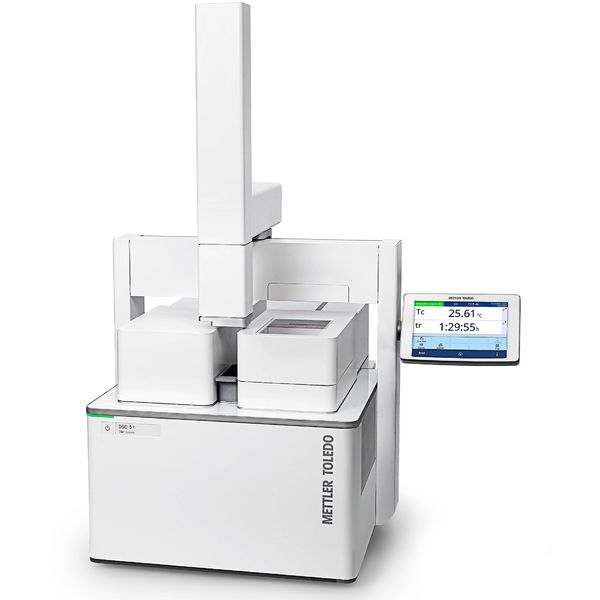
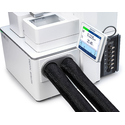
Thermal Analysis System DSC 5+
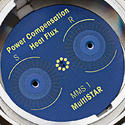
The revolutionary DSC 5+ comes paired with the new MMS 1, which has 136 thermocouples and 2 integrated heaters for power compensation mode and provides superior performance
Material No.: 30674095

Material No.: 30674095
Watch the video and discover the new standard in differential scanning calorimetry.
Measuring and evaluating samples is a time-consuming task, and it's difficult to ensure consistent interpretation and repeatable results when multiple operators are involved.
To tackle this challenge, DSC 5+ offers you a fully automated solution to simplify sample processing, interpretation, and result assessment, saving valuable time and effort.
Enjoy continuous measurement with automated exchange of up to 96 samples and 7 reference crucibles.
Prepare your samples in advance on removable crucible trays. The sample robot automatically detects the tray number and sample position, and applies the correct method.
The universal gripper handles all crucibles ranging from 20 to 160 μL.
Protect your samples before measurement by purging the crucible chamber with an inert gas, such as nitrogen.
To prevent contamination of fresh samples and free up space on the crucible tray, the robot can automatically drop the used crucibles in the crucible bin.
For sensitive samples the crucible can be hermetically sealed to prevent any changes in sample mass before the measurement starts.
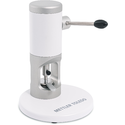
Just before the measurement begins, DSC 5+ robot's built-in needle pierces the special crucible lid making a precisely defined hole without coming into the contact with the sample.
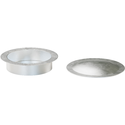
Sensitive samples can also be protected with a special removable lid.
The robot removes the lid just before the measurement starts.
After the measurement, the robot puts the lid back on the crucible and returns it to the tray.

The METTLER TOLEDO DSC 5+ redefines performance. The innovative MMS 1 sensor features 136 thermocouples as well as 2 integrated heaters for power compensation mode. This enables extremely accurate measurement of both weak and close-lying effects. The 96-position sample robot boosts productivity and ensures safe crucible handling without operator intervention.
Download the brochure to see how you can perform more experiments, in a shorter time, with fewer resources.
For the first time, a single furnace DSC can measure with power compensation.
Two integrated heaters in the state-of-the-art MMS 1 sensor keep the temperature difference (ΔT) between the sample and reference as close to zero as possible. During a measurement, any enthalpy change in the sample is compensated by the appropriate heater so that ΔT = 0.
The amount of heat power introduced to compensate for any enthalpy change is very precisely measured, leading to a heat flow signal with outstanding resolution.
Watch the short video above to see the sensor heaters in action!
In power compensation mode, the very short signal-time constant provides excellent resolution and the ability to separate close-lying thermal effects.
Together with the star-shaped arrangement of 136 thermocouples, this provides a single sensor with both outstanding resolution and amazing sensitivity.
The two integrated heaters enable the patented electrical heat flow adjustment across the entire measurement range.
For the first time in DSC history, thanks to two integrated heaters in the MMS 1 sensor, electrical heat flow adjustment is available for the entire temperature range. The heaters provide a pulse of heat every 50 K, which is very accurately measured. No samples are required and there is no operator bias.
This unique, patented feature saves valuable time and your DSC is always correctly adjusted over the entire temperature range.

The heat flow from the furnace to the sample is compared to the heat flow from the furnace to the reference crucible.
If a thermal effect or enthalpy change occurs in the sample, its temperature will deviate (∆T) from the reference, which follows the programmed temperature. The heat flow is precisely calculated from the measured ∆T.
Watch the short video above to see how ∆T changes during a typical DSC measurement.
136 thermocouples guarantee flat baselines and high sensitivity for measuring weak thermal effects.
For the first time in a single furnace DSC, you can easily switch between power compensation or heat flux mode, depending on your needs.
In power compensation mode, the power introduced by the sensor heaters is very precisely measured, providing excellent resolution for separating close-lying thermal effects.
The star-shaped arrangement of thermocouples means both heat flux and power compensation mode provide outstanding sensitivity for measuring weak effects.
You can select the mode, according to the needs of each experiment!

The revolutionary MMS 1 sensor of the DSC 5+ represents a huge leap in DSC technology.
With 136 thermocouples plus 2 integrated heaters for power compensation mode, we provide a single sensor with an extremely fast signal time constant for high resolution, and an exceptional signal-to-noise ratio for increased sensitivity.
The ceramic sensor is incredibly robust and chemically resistant. Measurements can be performed at high temperatures in aggressive atmospheres without risk of corrosion.

The two-layer design provides unmatched sensitivity for DSC. With two layers of 68 thermocouples, the measurement signal is amplified, providing an exceptional signal-to-noise ratio.

Two heaters (250 µW each) are integrated into the sensor, one under the sample and one under the reference. They are activated during measurements in power compensation mode.

Two temperature sensors precisely measure the absolute temperature of the sample crucible and reference crucible. The MMS 1 sensor is capable of measuring temperature in the range –150 to +700 °C
Automated reference crucible exchange: When the sample crucible type changes, the robot exchanges the reference crucible ensuring a flat baseline for your measurements without the need for manual intervention. No more waiting around just to change the reference crucible!
Automated sample crucible exchange: The robot places the sample on the sensor and the measurement starts. After the measurement, the robot returns the sample crucible to the tray and moves on to the next experiment.
Automated crucible disposal: If required, the DSC 5+ robot disposes of the used crucible into a dedicated crucible bin. This prevents contamination of fresh samples in the crucible chamber.
Watch the video to learn about our innovative hardware and software automation solutions.


Download the brochure to discover the most complete and comprehensive thermal analysis software on the market.
| Temperature Range | -150 °C – 700 °C |
| Temperature accuracy (±) | +/-0.2 K |
| Signal Time Constant | 0.7 s |
| Indium peak (height to width) | 25 |
| Cooling rate | 0.001 to 50 K/min |
| TAWN resolution | 4 |
| TAWN sensitivity | 66 |
| Technique | Differential Scanning Calorimetry (DSC) |
| Sensor Output | Heat Flow |
| Data Sampling | Max. 50 data pts/sec |
| Applications | Crystallization Glass Transition Heat Capacity (cp) Kinetics Oxidation Induction Time (OIT) Temperature Modulated DSC |
| Sensor Types | MMS 1 |
| Temperature precision (+/-) | 0.02 K |
| Heating Rate | 0.001 to 200 K/min |

Material No.: 119410

Material No.: 27220

Material No.: 26731