
Do you need professional support finding the right instrument for you?
Good Moisture Analysis Practice (GMAP™) is a scientific, risk-based guideline to ensure your moisture analyzer is fit for your specific application.
Check Now!


Do you need professional support finding the right instrument for you?
Good Moisture Analysis Practice (GMAP™) is a scientific, risk-based guideline to ensure your moisture analyzer is fit for your specific application.
Check Now!

Access validated application notes and technical SOPs for moisture content determination. Tailored for food, pharmaceutical, and chemical industries, these resources provide the technical framework necessary for measurement precision and compliance with global regulatory standards.

Simplify the creation of customized method parameters for diverse sample types. By optimizing temperature and switch-off criteria, we ensure rapid, repeatable moisture determination that aligns with official reference methods (e.g., Loss on Drying) for laboratory efficiency.

The Mettler Toledo Guide to Moisture Analysis defines the fundamental principles of thermogravimetric moisture determination. It offers expert insights into sample preparation, instrument calibration, and troubleshooting to help users obtain the most accurate results while minimizing experimental errors and measurement uncertainty.

We are committed to lab weighing excellence, combining cutting-edge measurement science, deep regulatory expertise, and industry-specific insights. Our relentless focus on innovation and continuous improvement allows you to optimize processes, ensure compliance, and achieve outstanding performance every day.

Our commitment to lab weighing quality ensures that every solution you choose performs reliably and delivers lasting value. Swiss engineering excellence, premium materials, and rigorous testing mean that you can trust your analytical results for years to come.

Our culture of lab weighing innovation compels us to continuously redefine our performance standards. This translates into forward-thinking benefits such as the easy ability to integrate automated, high-precision weighing into comprehensive analytical workflows, eliminating manual errors, ensuring traceability, and shortening time-to-result.

Your partnership with lab weighing is built on a shared goal of producing the most accurate and efficient weighing experience possible over the whole lifecycle of your instrument. Our dedicated worldwide network of highly trained service technicians provides you with unparalleled service and support across your entire operation to optimize performance and ensure peace of mind.

In lab weighing, sustainability is an important part of our approach. We deliver durable, efficient analytical solutions designed to minimize waste, and reduce environmental impact throughout the equipment lifecycle.

For METTLER TOLEDO lab weighing, integrity means fostering a culture where the needs of both our employees and our customers are consistently respected and supported. This is demonstrated by our commitment to innovation, quality, performance, and service that spans the entire lifecycle of every piece of equipment we produce.

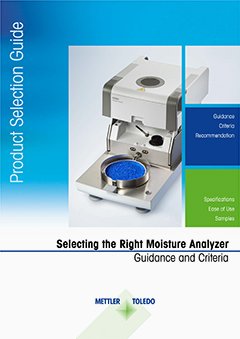
Finding the right moisture analyzer for your application is not always easy. The best moisture analyzer is the one that fits to your specific requirements. Typically, requirements not only concern measurement performance but also other factors such as ease-of-use, data management capabilities, robustness (long instrument lifetime) and compliance features. METTLER TOLEDO offers a wide range of reliable instruments that cover basic, all-round and high-performance requirements.


