Manage your online profile and customize your mt.com experience
Browse a custom portfolio, access quotes, and manage your installed devices on our extended digital platform.

Fast and reliable moisture results help you increase productivity, optimize processes and save money.
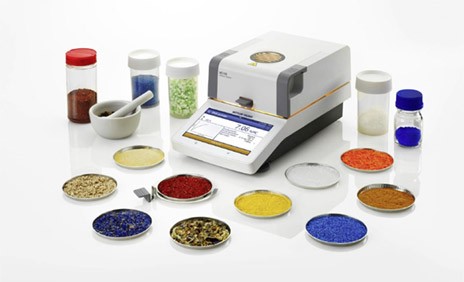
Get highly reliable and repeatable total solids results thanks to fast halogen infrared heating and superior weighing performance.
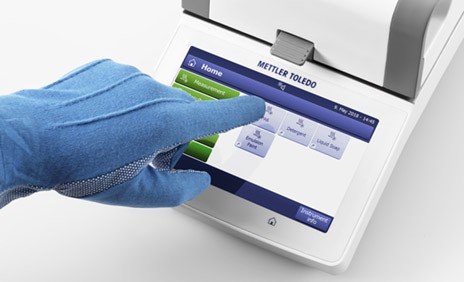
The HX204 and HS153 infrared solids analyzers deliver highly accurate and repeatable results for any sample type, and can fulfill all compliance requirements.
Touchscreen operation and user guidance make it simple to determine total solids in a wide range of samples. The compact design and robust construction make the HC103 ideal for use in both the lab and at production.

Users can start their drying methods directly from a shortcut on the home screen. Onscreen user guidance simplifies operation and minimizes errors even for untrained operators.

Tough housing and robust components ensure a long instrument lifetime even in harsh conditions.
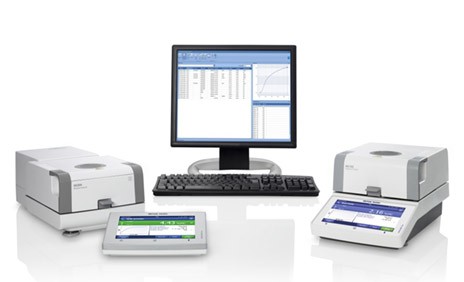
Data transfer is available via USB, Ethernet, Wifi and RS232. With EasyDirect™ Moisture PC software, you can save all data in a SQL database and visualize total solids analysis results, or simply print your results on a network or strip printer.
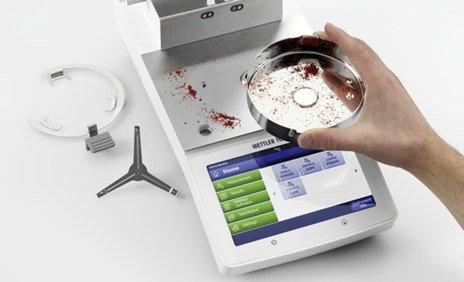
Thanks to flat stainless steel surfaces, you can clean the total solids analyzer quickly and easily.

Ensure compliance and fulfill ALCOA+ requirements, thanks to quality and user management functionalities.
The performance of any laboratory instrument can vary over time due to a number of factors. For this reason, it is highly recommended that every instrument be checked regularly in order to ensure consistently reliable results. Typically, a moisture analyzer is tested and calibrated by a service technician once or twice a year. Between service visits, a moisture analyzer should be routinely tested by the user to verify its ongoing performance. This shortens the period of uncertainty between consecutive tests. Let's listen to what Dr. Bob McDowell has to say about instrument calibration and testing. There will be an initial qualification and calibration that is repeated every 6 to 12 months, depending on how frequently the instrument is used. In between these intervals, I want to know, as an auditor, how your instrument performs and what the quality of the results coming out is. Because if you have a problem, it can affect all the results produced since the last requalification. A moisture analyzer consists of a heating device and an integrated weighing unit. A fault in either module could potentially cause errors in results. The service technician tests both modules independently using a temperature calibration kit and a calibrated test weight. A final overall system test is performed with SmartCal. It is highly recommended that the user also applies SmartCal in routine performance testing. SmartCal is a unique test substance with a known moisture content that can be used to test the overall performance of a moisture analyzer with a single standard moisture measurement that takes just 10 minutes. To run the SmartCal test, select the integrated SmartCal method from the menu. Enter the room temperature and relative humidity directly into the device in order to automatically normalize the SmartCal result. Tare the sample pan. Open the SmartCal test sachet and distribute the entire contents evenly over the pan. Place the sample pan into the moisture analyzer, close the lid, and the test starts automatically. The test is finished in just 10 minutes. The normalized moisture result is displayed on screen. and is automatically documented in the built-in control chart. If the result lies within the set control limits, then your moisture analyzer is working correctly. The control chart visualizes instrument performance over time. Trends can be detected before a problem even occurs. And as an auditor, that's a way for you to demonstrate to me that you're in control and that your instrument produces reliable results. Remember that prevention is always better, faster and cheaper than the cure.
Be compliant and ensure ongoing instrument performance with SmartCal™, a simple 10-minute test verifies overall solids analyzer performance.
Ensure accurate total solids analyses with accessories for correct sample preparation and handling. Benefit from data management software, and printers for easy documentation of your total suspended solids results.
Discover SmartCal™, the unique test substance that enables you to verify the performance of your solids analyzer in a simple 10-minute test. Test at the point of use to ensure trusted determination of moisture and total solids results.
Our guide walks you through important criteria to consider when purchasing a IR moisture balance. From interpreting technical specifications to understanding the functionality and performance of a infrared moisture balance from a holistic point of view.
Learn more about infrared solids analyzer and total solids analysis in different industries. Get valuable information on drying method development and correct routine testing to ensure accurate and reliable solids content results.
Routine testing of the heating and weighing units is necessary to ensure your solids analyzer is functioning correctly and your total solids results are reliable.
Take advantage of the 100+ drying methods developed by our moisture application specialists. Ready-to-use, and fully tested and validated against the drying oven method.
A soilds analyzer determines the totals solid of a sample with the loss on drying method and consists of a weighing and heating unit (infrared). It is often also called moisture analyzer or moisture meter.
Have you ever asked yourself why mascara sticks perfectly to your eyelashes? Or what makes cookies so crunchy? What makes the difference? The answer is simple. Correct moisture content. If the moisture content of mascara wasn't right, it would be very hard to put on and it wouldn't give the desired effect on the eyelashes. And we all know how it feels to bite a very dry cookie. But what exactly is moisture content and how is it measured? Let me explain you. The moisture content is measured by weight loss on drying. In this procedure, a sample is heated at a given temperature so that the contained moisture evaporates. I know what you are thinking. Moisture? Weight loss? Drying? Sample? Not quite. Let's have a closer look. A sample is a small part or quantity that is intended to represent what the whole is like. Take any sample in a given environment and record the weight it has. This is called the wet weight. Subsequently, start heating the sample by any measure to a given temperature. Wait until the weight is stable again. This is referred to as the dry weight. Moisture content is accordingly anything that evaporates upon heating, or the wet weight minus the dry weight, expressed in mass percentage of the wet weight. This relationship can be graphically represented with the so-called drying curve. Moisture content therefore might not only be water, but include alcohols, oils, greases, odors, like I said, anything that evaporates upon heating. Now that we have a common understanding of what moisture content and weight loss on drying is, let's see how Mettler Toledo moisture analyzers can assist you in easily performing this measurement. A moisture analyzer consists of a heating unit, in this case a halogen bulb, and a weighing unit, in this case a high-performance MFR load cell with hanging weighing pan. Thanks to the intuitive user interface, all Mettler Toledo moisture analyzers are very simple to operate. To perform a measurement, simply select a predefined method and follow the on-screen instructions. Learn more about METTLER TOLEDO Moisture Analyzers. Working principle of a moisture analyzer: Moisture content is measured by weight loss on drying. In this procedure a sample is heated at a given temperature so that the contained moisture evaporates. A moisture analyzer accordingly consists of a heating and a weighing unit. After determining the start weight, the sample is heated and the weight is continuously recorded. With touchscreen operation and user guidance, METTLER TOLEDO moisture analyzers are convenient and easy to use. The robust design ensures reliable moisture analysis results for years to come, whatever types of samples you have. Weigh in the sample into the tared sample pan and distribute evenly over the entire pan. Hit the start button. The instrument now records the wet weight. Now the sample is heated by IR radiation and the loss in weight, or the moisture content, is continuously recorded. When mass consistency has been reached, the instrument automatically stops the measurement and the end result is documented. Either directly on the device or alternatively on a printer or a network file server. Using a Mettler Toledo moisture analyzer is a fast and easy way to determine the weight loss and drying. Automatic calculation of the end result, clear user guidance, trusted results. Moisture matters for assuring best product quality at all times.
Total solids are determined measuring the dry content in water or solvent by evaporating all the water using a solids analyzer from the sample. Total suspended solids are measured by filtering the sample prior to the measurement and subsequently determining the amount of solids retained in the filter, the result is expressed in mg/l of solids. Total dissolved solids are accessible by evaporating all the water from the filtrate (liquid that passed through the filter).
An example with detailed description can be found in our waste water application note:
A solids analyzer works according to the thermo-gravimetric principle, also often referred to as the 'Loss on Drying' (LOD) principle. The solids analyzer consists of two components, a balance unit and a heating unit. In order to measure the solids content the sample's start weight is recorded. Afterwards, a halogen lamp or other infrared radiator heats and dries the sample while the integrated balance continually records the sample weight. When the sample no longer loses weight the instrument shuts off and the total solids content is calculated.
Our soids analyzers meet the moisture and total solids determination needs of quality control, production and in-process control, offering:
Finding the right solids analyzer for your application is not always easy. The best solids analyzer is the one that fits to your specific requirements. Typically, requirements not only concern measurement performance but also other factors such as ease-of-use, data management capabilities, robustness (long instrument lifetime) and compliance features. METTLER TOLEDO offers a wide range of reliable instruments that cover basic, all-round and high-performance requirements.
Get your personalized solids analyzer recommendation here:
The heating source (halogen lamp, metal rod, ceramic, quartz lamp) and its regulation are defined as a heating system. All mentioned heating sources are infrared radiators. This means the sample is heated by absorption of infrared radiation.
The most important performance factor is precise and fast temperature regulation, which is best delivered by halogen lamps because of their low mass and therefore fast reaction time. This ensures repeatable results starting from the first measurement (some other heating sources either deliver different results in the first measurement or require a warm up measurement, which wastes time and resources). Furthermore, an even heat distribution on the sample surface is essential for repeatable and reliable results. We advise you to ask us or another manufacturer for a demonstration in order to experience the performance in real-life.
We recommend the HX204 solids analyzer. It contains a high-performance weighing cell with 0.001% total solids readability separated from the heating source to ensure the best moisture results, even when measuring a substance with very low solids content.
It is possible to control all METTLER TOLEDO solids analyzers remotely, thanks to the comprehensive MT-SICS command set, which is provided as a standard. However, only the HX204 is suitable for automation due to its automatic lid. This allows you to fully automate total solids analysis, including the selection and initiation of different drying methods.
Replacing your existing solids analyzer is an important decision. If you have an old solids analyzer model that we no longer manufacture, we recommend that you consider one of the following solids analyzers as a replacement to ensure optimal performance: