This Transcript is AI-Generated
Illtud Dunsford: It is a technology that essentially replicates the human vascular system. So the way in which we, how nutrients pass through our own bodies or through livestocks bodies to grow muscle.
Micah: So what is this technology? It's a one of a kind. Bioreactor built to grow real animal cells just without the animal.
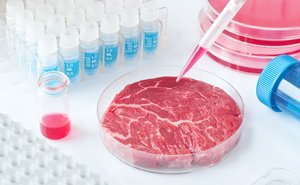
We're talking about cultivated or lab grown meat, and it's part of the fast moving game, changing alternative proteins field.
Illtud Dunsford: I came into this industry in 2015. I genuinely did not think that within five years at that point, it would be a product in market.
Micah: In this episode, you'll meet a dreamer from a traditional farming family who's reshaping the future of food.
We'll break down how their unique bioreactor works and explore traditional agriculture's complex relationship with this emerging field. And for an earlier conversation about the future of cultivated meat, check out season one, episode one. I'm Mike Schweitzer. And this is Balancing the Future from METTLER TOLEDO.
On this show, we delve into the world of science and technology and explore its transformative impact on our lives.
Can you start by just walking us through you and your family history and background in farming?
Illtud Dunsford: Absolutely. I, I live on the family farm and it's been in our family well over 300 years. And so I come from this kind of farming tradition, so a mix of livestock, um,
Micah: some forage and so on. That's the voice of Ida Dunford, CEO, and co-founder of Cellular Agriculture Limited.
Illtud Dunsford: Our land isn't the highest grade of land, so modern varieties of arable products wouldn't be, uh, the kind of things I took it over in 2010. I've always felt an affinity with the soil, especially with having a long family tradition, the sense of being a steward and being your role as within a certain period of time, of, of looking after the, the piece of land that that exists.So it's don't really see it as, as ownership as more in, in taking care for the next generation.
Chai: And what type of farming did your family, or does your family continue to do?
Illtud Dunsford: So when I, when I took over the, the farm, uh, my oncologist just sold his, his dairy herd and we hadn't had the huge amount of investment before that time.
So I was focused more on the livestock for meat. I diversified the farm at that time and set up a, uh, meat processing business. And so focused very much on adding value to our own own livestock. And that was range we predominantly pigs in terms of the production of food products then, and actually had, again, relying on tradition and, and some heritage diversified a into a meat business that was based on the historic pre refrigeration methods of how you cure a meat.
The roots of sit quite so deeply in. How we used to sustain ourselves before modern technologies, and that then grew as a business, uh, into something that was much more to do with knowledge economy and, and supporting product development and, and much bigger clients than just supporting our own family farm.
Micah: And you've really made a bridge the gap here between traditional methods and modern technology. But take us back to what your initial reaction was to the idea of cultivated meat as somebody who is raising livestock.
Illtud Dunsford: I first really came aware of cultivated meat by 2013 when there was the first public demonstration of a hamburger that was cooked in in London at that time, and I.
I didn't really know what to think of it at that time, but it created enough of a buzz for me to want to learn more. And so I started looking then to see if I could find a conference that I could go to to learn a bit more, and found one in 2014 that I couldn't attend. Found another then in 2015, and that really was my deep dive, and I actually went with a, a farming friend from Australia.
And we were sat in the back of this conference thinking, what are we doing here? I mean, we've, we've got a room full of scientists and Silicon Valley VCs and us as two farmers don't really sort of fit into this picture. You know, the whole purpose was to learn more. But there was probably a sense of a barr to begin with because it sat so far away from the kind of traditional vision of agriculture, the kind of old McDonald's farm storybook version of it.
Is really quite different to, I mean, that's quite different to the industrial food system anyway, but nonetheless, you know, this idea of being able to grow something in a land felt like a huge leap for me to consider. So it took some time for me to wrestle with the idea.
Chai: And so what was the actual turning point that did convince you that the technology wasn't a threat to agriculture, but actually an evolution that's very necessary?
Illtud Dunsford: So at the time of that particular conference, I was doing a lot of work in. Adding value to byproducts or co-products from the livestock industry. So looking at how you could further process blood fat, skin bone into food rather than into waste or into other uses. And during that conference, there was a, and it's an often used quote nowadays for the cultivated meat industry, but in the 1930s.
Churchill had written an article about what he imagined the future would be in 50 years time, and one of the paragraphs in that sort of thought piece was to do with his imagined future for food. And he'd imagined growing a chicken breast, but without the whole animal. And there was me looking at carcass balance and utilization and all of these things that were, you know, if we were to utilize an animal for food, then we need to use every single part of it.
Here was a technology that actually we could actually just consume the part that we as consumers wanted to consume. And what's
Micah: driving this shift to cultivated meat? I.
Illtud Dunsford: We were looking at the challenge of how do you feed a growing world population? And the focus in that previous business was looking at how did you add value to the bits that people didn't want?
And this is essentially another tool in that toolbox to feed that population. Then it's to do with food security. And I think if I, if I go back to that period. There was research being done at that time, looking at planetary boundaries. How do we currently produce food? Another version was published in 2023, but we already exceed a number of those boundaries in traditional farming.
So it's, it's not that we just need something for the future. We need something. Now
Micah: we've put some information in the show notes if you'd like to learn more about planetary boundaries and what they mean for human survival. So if we go back to our chicken, what I'm hearing from you is that we either need to use all of the chicken if it's an actual chicken, or we can say what part of the chicken do we want and leave out all the other bits.
Illtud Dunsford: It's probably not an either or. It's probably we need to do both. And cultivate meat isn't a silver bullet. It's one of these sort of tools in this toolbox. We need all the technologies within fermentation, precision fermentation. We need new technologies within traditional Ag Tech as well, because we have got a huge challenge.
We produce too much food at the moment for the population that we have, but we waste a huge amount of it. So there's a simple choice. Do we use consumers change? Consumer change is very, very hard. There seem to be simple answers, but actually we are now looking at complex solutions to fix things that we aren't changing as humans.
Chai: And how did engaging with the wider farming community really help shape your transition and perspective on the issue? I.
Illtud Dunsford: I think that the first step is the considering. Is it a threat? Is it a potential threat? And so in those early years, I'd say sort of 20 15, 16, 17, it was a difficult time to be a farmer within the farming community, specifically working in this field.
But since then, there's been so much more discussion. There's been so much more academic funding. Where there's been the ability to have open conversations, and that's been a huge benefit really, because once you get over that initial reaction, it gets easier in terms of conversation because I think farming's a very specific industry.
It's very personal, it's very family orientated. It's very much something that's passed from one generation to the next. So anything that seems to be criticism is taken very, very personally.
Chai: Yeah. And I was gonna say, did you have to have a lot of heart to hearts with your own family in order to convince them of, uh, cultivated meat?
Illtud Dunsford: To be perfectly honest, I'm not sure even my own family fully understand elements of it. 'cause it's, it's highly complex, you know, scientific technology and you scaling something like that is a challenge in, in any kind of food ingredients within the food industry. That's complex. But I think they. They're very supportive nonetheless, you know?
But to be honest, I'm the non-technical person within the, the leader within the business, and so I don't understand the minutiae of how everything works.
Micah: Scaling is an issue though, even within traditional agriculture. I mean, that's how we wind up with approaches like industrialized agriculture, which has its own challenges of course.
Illtud Dunsford: Absolutely. And I think that's the part for me when I entered into the industry was to understand where was my role to play in this. And I think within that first conference, I really struggled to understand and scale because at that time I asked a member of the audience who has since become my co-founder, if there was a possibility of me having 20 kilos of cells from her research group, the University of Bath.
And she just yelled, laughed at me and said, there's not 20 kilos of cells ever been produced for this. Sort of application. And so it made me really understand where the industry was at that time and. Food is the, a manner of scale that's very, very different to many things. You know, it's, it's something, you know, we, we all reliant on it.
We all consume it. There's this global system that's very, very intricate in order for us all to have something to eat. So it's, that isn't comparable to the applications or the technologies that were being used for. The biopharma, biomedical industries.
Micah: Now we'd love to learn more about your specific technology and what you're doing differently with your bioreactors. I understand there's a membrane technology that you've implemented. Can you talk about that a bit?
Illtud Dunsford: It's a technology that essentially replicates the human vascular system, so the way in which nutrients pass through our own bodies or through livestocks bodies to grow muscle.
So each of those membranes is like a blood vessel, and so the nutrients pass through the center of that membrane and pass through the wall of the membrane to feed the cells that ultimately become the muscle. And so essentially it's a way of replicating or mimicking existing biology. And it's quite different to the technology that currently exists in biomedical industry because that technology has never been designed or scaled for the production of food in this case, or muscle cells or meat cells, or actually any, any other kind of cell culture that relates to food, whether that's dairy or, or even plant cell cultures for cocoa or coffee.
Micah: You know, we've talked a lot about cultivated meat, but we haven't really dug into cultivated plants yet. It really is a fascinating topic and could have its own dedicated episode that outlines the environmental and societal reasons for growing these cells in a bioreactor. With plant cell cultivation, you're not growing the whole tree or shrub, you're just growing the specific cells you need, like coffee or cocoa cells inside a bioreactor.
It takes way less land and water and the process can be more stable and sustainable. And compared to cultivated meat, plant cells are fairly low maintenance to grow. They don't need complex scaffolds or animal growth factors. They naturally grow in clusters and they're tough. That means the systems to grow them can be simpler, cheaper, more scalable.
If cultivated plants is something you'd like to hear more about, leave us a comment and we might just include it as a future episode. The fact that Ted's bioreactors can grow both meat and plant cells is pretty remarkable. So how does this technology actually work? Because
Illtud Dunsford: it's a technology that's designed for the application of food, it's got some significant efficiencies.
And I guess what I always tend to say is you can produce more cells in a smaller space than any other system. So generally the footprint is at least 50% smaller. That then has a huge effect on the capital costs in terms of the materials needed to build that system, and essentially the factories of the future, but also the reduced labor units that are needed.
For the system to run it, which then has a, an effect on, on the operational cost. We've always, because we are designing a new system, we keep that circular economy in mind as well when we come to the design of this technology so that we know that even some of the components like the membranes themselves will likely in the future be a recyclable to be made into new membranes.
So there's a circularity in the system for the future.
Chai: And how long does it take to grow the cells or the membranes?
Illtud Dunsford: That's down to biology. So how much time does a, a cell take to replicate? So as a system, it's a cell agnostic system, so it's purely dependent on future customers', choice of cells and, and feedstocks as to how long that could be.
But we've worked with varying cells that have got different doubling times, so it can take a, a matter of days or it could take a matter of weeks depending on the efficiencies of those cells.
Chai: And do these cells have a similar amount of nutrition and compared to traditional meat?
Illtud Dunsford: Absolutely. So it's a key point of looking at technologies.
Currently, not all existing technologies allow cells to be grown through the stages of proliferation, which is when they multiply, and then differentiation, which is the stage in which they, they mature into the equivalent of what we would consume within traditional meat. And so that's one benefit of the system is you're able to do both stages.
So. Products on the market at the moment are largely proliferated cells. They haven't had that maturation stage. And from our own data, it has a similarity in that stage to traditional meat, but not, not an equivalent. Whereas if you go through the fill process of going through differentiation, that's when you see a comparative nutritional profile to traditional meat.
Micah: Now you talked about the compactness and efficiency of the system. What about scalability? Can this support commercial scale production?
Illtud Dunsford: Absolutely. 'cause it's a modular system, so it's, there's a, we've already, last year, one of our key milestones is we've built the longest ever holo fiber membrane bioreactor for any form of cell culture application.
So that actually is quite a bit broader than just cultivated foods that also has applications in, in biopharma and other industries. That was the challenge for us was to see, so how big can you get before the, when you then start scaling out rather than scaling up. And I think the challenge that the industry is facing at the moment is using incumbent technologies and seeing how big can we get with a tank.
Our approach is very different. It's if there's a modular approach, it needs to be. A system that you can handle and the system that is actually usable in the factory setting. And so we've actually looked at water treatment industry and how they currently have banks of membrane treatment systems.
Essentially, if you look at, at what a water treatment system would look like with revers, osmosis or, or membrane treatment, our factories actually probably look very, very similar in the future.
Micah: So you might be wondering why not just use stainless steel tanks like the ones already used in food production?
It's a fair question. After all, that's how we brew beer. You've got yeast in big metal tanks, eating sugar and turning it into alcohol. There are many parallels between brewing and fermentation processes. Used to create some types of cultivated cells, but growing cells is a lot more delicate. Those traditional tanks create sheer stress forces that can damage or destroy the cells.
Even with genetic engineering, making them tougher, they still need extra support like scaffolds or particles, especially when you're trying to build structured meat. Plus, there are practical issues, yield limits, scale problems, even a global shortage of stainless steel. There's just not enough to support production at an industrial level.
So let's get into the finer details of how Ed system works, and even more specifically how it manages waste. I.
Illtud Dunsford: Essentially, the way in which we deliver nutrients is exactly the same as that. That we would grow cells or we would grow muscle in the human body, or cattle would grow muscle. And so the, the delivery of nutrients is highly targeted to the cells.
So in a tank, you know, a cell is floating within within the nutrients, but it's also. Anything that that cell excretes in terms of waste is also in that area until it's taken away. Now, because it's a perfusion system that we have, the nutrients go through the center of the fiber directly to the cell, but also the waste is carried away at the same time, and so it's a much cleaner system for the cell.
To be able to live in an environment that's far more suitable for growth than what is currently being offered.
Micah: If I look at the conversation that we're having so far, we talk for a while about traditional farming and now we've been talking about biological processes and factories of the future. You of course bring these together in one person, but how do these synthesize in your mind?
Illtud Dunsford: I've always thought of kind of the bigger picture, and I really, that's sort of my starting point, is how, how do we get to, to where we need to get to as a, as a planet?
And I'm so connected to that kind of starting point of soil because I'm looking forward already to, to next weekend where I know I'll be spending time in the garden. So growing vegetables on, on whatever scale, even though we use a tractor and machinery to do it, I still think of it as as kind of gardening.
And along this journey, it's been a challenge for me to bring others from the agricultural world into the conversation. And to see whether they get to the same point as me in thinking of how we need these other technologies and how we should be embracing other technologies. And that could be, I know, a biological innovation within AgTech.
It doesn't have to be something as such a leap into kind of synthetic biology. But there needs to be a bridging because essentially for the challenge for me is the end product. It is the food that we consume as a consumer. And it's not about thinking about, well, we've always made it in this specific way.
It's about working back to see, well, how can we make this a bit in a different way? And so it's an evolution as far as I'm concerned, of agricultural practice rather than a dissolution of it.
Chai: In what role do you see farmers playing in a cell-based food future?
Illtud Dunsford: I think we got a, a very important role because.
The nutrition that cells consume still comes from primary agricultural products. The primary energy source is glucose. Traditionally, that would've come from corn or maze. It could come from more, so more efficient would be wheat, but also could come from agricultural wastes. Interestingly, over the last few years, we've supported a project that the Royal Agriculture University did in the uk.
That was looking at some threats and opportunities for UK agriculture in the future, and it was quite a broad project. It wasn't specifically, although it was looking at cultivated meat as the primary topic, it looked broader at the changes in agricultural subsidy in how we, we go to most of high nature value farming.
It made us consider climate change. So it brought a number of other factors to consider. Are there some more near term threats to the agricultural community? And then where does cultivated meat sit within that, whether it's near term or or future. And we actually comes in as an opportunity. So we looked with the University of Sheffield, led on work looking at.
Those primary agricultural inputs into the feedstocks. But also there were kind of eight scenarios or case study farms where we went to see is there an opportunity for some of these farmers to do something in the future? Whether they are contributing cells from a donor herd on one farm where they were having on farm production on another, whether another one which already had an established some pharma shop business or retail element, whether they could kind of include it in that.
And even horticultural businesses, ones who that were producing, uh, strawberries and blueberries from major UK supermarkets, actually looking at the production facility they already had, could they switch to do something quite high value within collectivity meat? Quite possibly, yes. So if those opportunities do come in, the feature, the agricultural community is very enterprising.
They're very used to having to change their business model to survive. So I'm quite confident there's a keen role for them to play in the future.
Micah: Which is very interesting because so often technological change and development results in, in US looking for winners and losers, like the development of the automobile was tough on wagon makers and farriers, for instance.
But you're saying that it's more complex than that. I.
Illtud Dunsford: I think the early narrative was to think of this as something that it would replace. I think the, um, the term at that time was a kind of a, a post animal bioeconomy, and it wasn't just looking at cultivated meat that was looking at a number of animal based byproducts that we use in other things in cosmetics and farm and so on.
But we have to be realistic about if you want to produce something and you want to produce it at a parity in terms of cost to the traditional, to be competitive, you have to use inputs that are low priced and where do they generally come from. It's from sort of commodity scale production. And in this instance, you know, all those inputs are huge reliant on, on agriculture.
Some of the very complex elements within the, the nutritional broth that, that you feed the cells could come from recombinant proteins or some form of fermentation or precision fermentation, but that's only a part of it. They are energy intensive systems. They are CapEx intensive systems. And so we have to be realistic about who invests in the future of food, you know, who is gonna invest their hardened capital to build, uh, the infrastructure that's needed for the future.
So we have to use
Micah: what already exists. In July, 2024, the UK's Royal Agricultural University published Culture Clash. A two year study exploring how farmers view cultivated meat. The top line results were that farmers show curiosity, but also caution. They worry about uncertainty, unreliable data, and how new supply chains would work.
Some see cultivated meat as unnatural, and question who truly benefits from the shift. Still the opportunity is there. The report suggests that some farmers can gain an edge by focusing on high value meat or supplying raw materials for cultivation. Others could boost their income by using crop or animal byproducts, or even start producing cultivated meat directly on their farms.
Early studies show that using byproducts cuts both costs and environmental impact. But farm-based cultivated meat production still costs more than factory based methods. Building trust and working together could help traditional farming and the cultivated meat industry grow side by side.
Illtud Dunsford: We are quite traditional in the kind of business that we are in terms of, of deep tech in the uk.
Our first few years wasn't through sort venture capital, it was through government support. It was through grant funding, it was through academic research. And so those stages to get to a point where we were ready for, for kind of investment, it exists here in the uk. But actually for new technologies that could fundamentally change, there's still a gap.
We work with a number of investors in the food industry because they have that experience of, of how food systems work currently and how, and they have the ability to have the capital to fund expansion. But realistically, the capital needed for us to take any of these newer technologies. To absolute scale is vast.
And so I think we have to be realistic. Governments need to have policies in place, they need to have funding in place, in support of new technologies, and that goes a across from all the way from the field to the final food product.
Chai: Now let's talk about the transition that society made. When GMO foods were introduced, at first there was maybe some fear about this type of food and hesitation, and this could be similar to the cultivated meat trend and revolution that's coming, and it took a certain. Side of marketing such as cotton, candy, grapes, and other fun products to really get people to accept these GMO products.
Could you see in the future there would be some hybrid product, perhaps plant-based meat plus cultivated fat?
Illtud Dunsford: Definitely and, and I think there's a lot of lessons to be learned from the way in which. GM technology was developed and then commercialized, how it became a kind of a, a polarizing issue. And I think culturally it's really quite different.
And if you think of Europe for instance, the view on GM is really quite different to what it is in North America. And similarly to, to Asia. So we have to be culturally sensitive about a consumer view of technologies, but we also need to be very transparent in the way that we roll out technologies so that people understand.
And I think that is definitely the challenge that the cultivated meat industry is facing. So some of the products that exist on the market now have actually taken that hybrid approach. One of the products at the moment, uh, the one that's in a, in a retail setting where you can purchase it and cook at home.
It only has a 3% inclusion of cells in it. And so that's, that's an exceptionally small amount of cells. But nonetheless, consumers have the ability to purchase that product, to have a taste of what the future will locally look like.
Micah: Are there countries or parts of the world where cultivated meat is most advanced?
Illtud Dunsford: Singapore is, is the country that currently has, I think, two different products on the market from two different companies. I mean, historically, the, the US United States led the way. And especially because the concentration of companies were there. But even though there are, there are two, uh, regulatory successes in the United States, you know, they, I'm, I'm not really aware of any product that's currently on the market.
It's sporadic at the moment, but Singapore seems to be the center point at the moment, and I know it has a favorable system for regulation from the some point that they prepared beforehand a framework of how to. Applications. They provided clear guidance. And so companies have had successes there because of the government support for the idea of, of how we need to produce food for the future.
Especially in their case, because it's a very, very small country, there isn't sufficient land to support prime agricultural production. And so their reliance then in terms of foods really came in quite sharply into focus during COVID and. They've now shifted their focus to make sure that they can, you know, that there, there is potential to invest in technologies for the future.
Sort of like what we've seen with like vertical farming in the Netherlands. Absolutely same. Same principle is how can we utilize, how can we produce more with less.
Chai: So have you connected with the vegetarian communities or vegan communities and had a discussion about cultivated meat and how it is different?
Illtud Dunsford: The early investment for, um, cultivated meat actually came from the vegan and vegetarian communities, and they're the ones that saw the promise in the technology for the future.
Now, that may have been a promise to reduce the number of animals and, and, and replace, but. And it has definitely has that, that there is the opportunity for that to happen. But I think obviously the role in which we've been supporting is more to do with, with food security. But nonetheless, the vegetarian, vegan community are really key parts of the conversation still.
And we were part of an incubator program with Pro Veg in Berlin in, in 2019. They manage one of the largest of vegan vegetarian accreditation, uh, labels, um, food products globally. I think the challenge that I. If we think of future consumers, I would like us to consider that anybody who's a current meat eater or what we classify as a, a non-meat reducer in their diet as well, would also be the key customers for this food product in the future.
Because essentially they, they can send percent to the market as it stands. So those are the people that we need to adopt this kind of technology in order for us to see that kind of level of lasting impact.
Chai: And if someone is looking to work in the field of cultivated meat technology, what would your advice be to them?
Illtud Dunsford: If you're still going through sort academia, there's now significantly more, or there are courses now that are focused on this field. You can come through more traditional biomedical or engineering tracks to the industry, but there definitely is focus in certain institutions and there are still sort center points for, for research globally.
I think historically that would've been, and the UK was one of them. Mass drift in the Netherlands and Tufts, uh, in Boston. They were really kinda the leaders in the early days, and there's many more now that have followed on from that. So definitely from an educational perspective, but then there's an active job market there for the companies that exist.
They're looking for diverse skillsets. They're looking for diverse minds and diverse viewpoints. So. It is an active industry that people can really sort of, they could have a significant impact in their role on the future of food.
Micah: And if you look ahead, what's your rough estimate in terms of timeline?
When we'll start to see cultivated meat, as, you know, a food offering in the supermarket, sort of like any other offering.
Illtud Dunsford: I'm amazed at how quickly we got to market. I came into this industry in 2015. I genuinely did not think that within five years at that point there would be a product in the market.
So we have done exceptionally well to accelerate that process. I always err on the, the side of caution in terms of when I'm promising in terms of technology. But if I think of where we are as a company, within the next two years, we will have a technology that is scalable. But if we think of traditionally how technology scales, it does take time.
And so to be realistic, could we start seeing large scale plants being built in order to, to supply supermarkets within the next three to five years, or definitely hope so because that's what the industry needs. In order for it to, to get to the next stage,
Micah: we've been speaking with Ida Dunford, he's the CEO and Co-founder of Cellular Agriculture Limited. A few things that really stood out to me from this conversation is first of all, IED himself, because he started out, of course, as a skeptical farmer attending a conference. On cultivated meat and eventually became a true believer and the founder of a meat cultivation company.
And I think his role in bridging traditional agriculture and this cutting edge technology is critical. And we see this so often around sustainability developments and sustainability questions that we really need an all of the above approach that we're not gonna shift from today to tomorrow from. A traditional method to a new technology that we really need all of the above and an expanding sense of what is possible to create a more sustainable future for ourselves.
And of course, we've talked a lot about cultivated meat today and in season one, episode one, but it's really interesting to think about. Plant cultivation in a bioreactor context, especially as certain crops are facing environmental uncertainty.
This has been balancing the future from METTLER TOLEDO. What questions about science and technology do you want answered in a future episode? Do you want to hear about plant cells and bioreactors? Let us know by leaving a review or if you listen on Spotify, leave us a message in the comment section and be sure to subscribe wherever you get your podcasts.