


Flash DSC Ultra-Fast Scanning Chip Calorimetry
A Quantum Leap in Innovation Opens Up New Frontiers
A Quantum Leap in Innovation Opens Up New Frontiers
Use patented technology to perform differential scanning calorimetry at ultra-fast heating and cooling rates. With METTLER TOLEDO's innovative Flash DSC, high heating rates enable material analysis without interference from reorganization, as there is no time for this process to occur. The high cooling rates allow the formation of materials with defined structural properties. You can also study the kinetics of extremely rapid reactions and crystallization processes.
By using a minimal amount of material placed directly on the sensor, effects caused by the crucible are eliminated, maximizing the accuracy of your results. Flash DSC is the ideal complement to conventional DSC.
/content/us/en/home/products/Laboratory_Analytics_Browse/TA_Family_Browse/Flash_DSC.fb.1.c.11.html
Ready to revolutionize your material analysis? Discover how today!
Discover the Flash DSC
Revolutionize Your Calorimetry
Watch the video and experience the fastest commercially available DSC! Discover how the ultra-fast heating and cooling rates of rapid scanning calorimetry open up exciting new application possibilities that were previously unheard of.
Discover Features and Benefits of Flash DSC

Ultra-High Heating and Cooling Rates
Ultra-high heating rates of up to 3 million K/min suppress the reorganization of the sample as there is no time for these processes to occur. Cooling rates of up to 2.4 million K/min influence the crystallization behavior and allow defined structures to be formed, such as those which occur during rapid cooling in injection molding processes.Ultra-fast DSC is also the ideal method for studying crystallization kinetics.

Lock In Your Atmosphere
No more unwanted reactions! Thanks to the gas-tight measuring head, you can investigate your samples under precisely defined atmospheres, for example, oxygen-free conditions.

User-Friendly Ergonomics and Functionality
Prepare and insert your samples while sitting comfortably in front of the instrument. Cut the sample to size on a glass plate and place it directly on the sensor. The sample can be repositioned using a stiff thread or even a piece of hair!
Innovative Chip Sensor Technology

Innovative Chip Sensor Technology
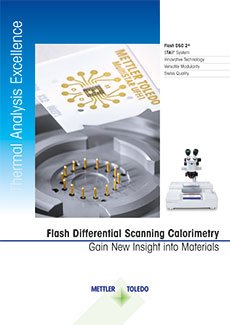
At the heart of the Flash DSC lies an innovative chip sensor based on MEMS (micro-electro mechanical systems) technology. Using this revolutionary technique, the sample is placed directly onto the sensor.
Or just give us a call
800 METTLER (800 638 8537)
Call Service Brochures


Datasheets and Guides


Expand Your Knowledge


FAQs
What is fast differential scanning calorimetry (DSC)?
Fast DSC, also known as rapid screening differential scanning calorimetry, is a rapid thermal analysis technique that allows for ultra-fast heating and cooling rates, typically in the range of thousands of Kelvin per second. This rapid thermal cycling enables the detection of very fast thermal events such as glass transitions and crystallization processes, that may be missed by traditional DSC techniques.
Check out our on-demand webinar to learn all about Flash DSC!
What is the principle behind ultra-fast scanning calorimetry?
Ultra-fast scanning calorimetry works on the principle of rapidly heating and cooling a small sample, typically in the microgram range. As the sample undergoes thermal transitions such as glass transitions, melting, or crystallization, heat is either absorbed or released.
The instrument measures the difference in heat flow between the sample and a reference. By analyzing the heat flow data, researchers can obtain valuable information about the thermal properties of the material.
How does Flash DSC differ from traditional DSC?
Flash DSC revolutionizes rapid-scanning DSC. While traditional DSC operates at much slower heating and cooling rates, typically in the range of 10-20 Kelvin per minute, which can limit the ability to detect fast thermal events, Flash DSC can capture these events by using ultra-fast heating and cooling rates.
What are the advantages of using Flash DSC?
Flash DSC offers a multitude of advantages over traditional DSC:
- High-Speed Analysis: Rapid thermal cycling significantly reduces analysis time, making it an efficient tool for high-throughput studies.
- Enhanced Sensitivity: The ability to detect subtle thermal events, such as weak phase transitions, is greatly improved due to the high sensitivity of Flash DSC.
- Accurate Kinetic Measurements: By providing precise kinetic data for fast processes, Flash DSC enables a deeper understanding of reaction mechanisms and material behavior.
- Improved Resolution: The high resolution of the Flash DSC allows for the separation and identification of overlapping thermal events, providing a more detailed picture of complex systems.
Download our free Flash DSC Innovation Guide to learn more about the benefits of Flash DSC and its many application possibilities for research and academia.
Which industries commonly use Flash DSC?
The versatility of Flash DSC has led to its adoption across various industries and scientific disciplines. Some of the key applications include:
- Polymer Science: Investigating crystallization kinetics, melting behavior, and glass transition phenomena in polymers and copolymers.
- Pharmaceutical Industry: Analyzing drug stability, polymorphism, and amorphous state, as well as understanding the impact of formulation changes on drug product performance.
- Materials Science or Failure Analysis: Characterizing phase transitions, curing kinetics, and thermal degradation in a wide range of materials, including metals, alloys, metallic glasses, ceramics, and composites.
- Food Science: Studying the thermal properties of food products, such as glass transitions, melting behavior, and crystallization, to optimize processing and storage conditions.
What are the applications of Flash DSC analysis?
The power of Flash DSC has been recognized by numerous industries: Below are some key sectors where Flash DSC is making a notable difference:
- Pharmaceutical Industry: To ensure drug product quality, stability, and efficacy.
- Polymer Industry: To develop innovative materials with tailored properties and optimize manufacturing processes.
- Materials Science: To advance the development of advanced materials for various applications, such as electronics, aerospace, and automotive.
- Food Industry: To improve food quality, shelf life, and consumer experience.
- Electronics Industry: To characterize the thermal behavior of electronic components and materials.
These examples demonstrate the versatility of Flash DSC and its significance within the field of rapid scanning calorimetry.
What is the heating rate of Flash DSC?
Flash DSC typically employs heating rates that can reach thousands of degrees Celsius per second. This extraordinary speed is essential for capturing rapid thermal events and obtaining accurate kinetic data, which is particularly beneficial in industries like polymers, pharmaceuticals, and materials science.
The Flash DSC 2+ by METTLER TOLEDO can analyze reorganization processes that were previously impossible to measure. It covers more than 7 orders of magnitude of heating and cooling rates, making it ideal for studying rapid crystallization and reorganization processes in a temperature range from -95 to 1000 °C. More specifications can be found here, or download the Flash DSC brochure.
Does the Flash DSC utilize fast scanning chip calorimetry?
Yes, the Flash DSC by METTLER TOLEDO uses fast scanning chip calorimetry technology to enable the analysis of rapid thermal events and high sensitivity for small samples.
This allows researchers to study dynamic processes in materials, such as rapid crystallization and phase transitions, which are often missed by traditional DSC.
What is the sample size for Flash DSC?
Due to the high sensitivity of Flash DSC, very small sample sizes, often in the microgram range, are sufficient for analysis. This makes it ideal for precious or limited samples.
What types of samples can be analyzed using Flash DSC?
Flash DSC, a powerful tool for rapid scanning calorimetry, can analyze a wide range of sample types, such as bulk materials, powders, fibers, nanofillers, including:
- Polymers: Thermoplastics, thermosets, elastomers, and blends.
- Pharmaceuticals: Drugs, excipients, and formulations.
- Metals and Alloys: To study phase transformations, solidification, and heat treatment effects.
- Ceramics: To investigate sintering, phase transitions, and thermal stability.
- Organic and Inorganic Materials: To characterize a diverse range of materials, from small molecules to complex composites.
What is the temperature range for Flash DSC?
The METTLER TOLEDO Flash DSC 2+ is the fastest commercially available rapid-scanning DSC, capable of analyzing a wide range of samples from -95°C to 1000°C, making it suitable for studying rapid crystallization and reorganization processes.
More specifications can be found here, or download the Flash DSC brochure.
How can Flash differential scanning calorimetry be used to study polymers?
Flash differential scanning calorimetry is a powerful tool for studying the thermal behavior of polymers. By rapidly heating and cooling samples, it can accurately measure:
- Glass transitions: The temperature at which a polymer transitions from a rigid to a rubbery state.
- Crystallization kinetics: The rate at which a polymer crystallizes from a molten or amorphous state.
- Melting behavior: The temperature and enthalpy associated with the melting of polymer crystals.
- Cold crystallization: The crystallization of a polymer when it is heated below it’s melting point.
By understanding these thermal properties, researchers can optimize polymer processing, improve material performance, and develop new polymer materials with tailored properties.
Watch our on-demand webinar to learn how Flash DSC can help you understand polymer crystallization behavior.