Vision Based Automation of Chemical Workup Steps
Automating the Last Bottleneck in Chemical Workflows
Program oversigt
- How to eliminate manual phase identification
- Vision-based reactor control in practice
- Closed-loop automation strategies
- Two real-world applications: Metastable zone automation and liquid-liquid extraction workflows
- How to integrate vision data into process control systems
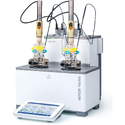
Binghui Wang of Takeda presents Vision Based Automation of Chemical Workup Steps and details the use of vision-based automation to eliminate manual workup steps and enable autonomous chemical processing.
While chemical reaction steps have become increasingly automated, workup operations, especially multi-phase separations, remain one of the last major bottlenecks in laboratory workflows. These steps often require manual intervention to identify phase boundaries, wait for settling, or confirm clarity, introducing variability, slowing down throughput, and limiting the scalability of automation strategies. As a result, many otherwise automated processes still stall after reaction completion, preventing labs from realizing the full potential of end-to-end autonomous experimentation.
In this webinar, Takeda demonstrates how a vision-based monitoring and control approach transforms these traditionally manual steps into fully automated, decision-driven workflows. By integrating real-time image analysis with reactor control systems, scientists can automatically detect phase changes, turbidity, and liquid levels—and use those insights to trigger downstream actions like heating, cooling, dosing, and separations. The result is a more robust, repeatable, and scalable automation framework that not only eliminates manual effort, but also enables continuous data collection, improved process understanding, and more efficient use of scientist time.
Target audience
About the Presenter

Binghui Wang, PhD
Takeda
Binghui Wang is a Staff Engineer in the Synthetic Molecule Process Development group at Takeda Pharmaceuticals. He earned his PhD in Electrical Engineering from the University of Illinois at Urbana–Champaign, where he focused on signal processing for remote sensing applications. Since joining Takeda in 2025, he has worked on automation and PAT, applying image processing and statistical modeling methods to support the development of new sensing approaches for real time process monitoring.