Guide to Crystallization Development

Avoiding Sampling and Offline Analysis
Obtaining a Representative Sample
Offline analysis is commonly used to determine crystal distribution at the end of an experiment or during a production run. While such an approach is common, there are limitations to offline analysis which are relevant for crystals:
- Crystals are delicate and change with temperature – making representative sampling and analysis particularly difficult
- Many crystal systems are toxic and do not lend themselves well to sampling
- It is difficult to take enough offline samples to determine how a fast changing process, such as crystallization, behaves with respect to time.
- The time delay between sampling and offline analysis is often too long, especially in production, to make relevant decisions that can improve product quality

Why Crystal Size and Shape Are Important
Improve the Product and Process
This set of ParticleView images neatly illustrates the complex size, shape, and structure of various crystals. From large round “boulders” to beautifully delicate “dendrites”, crystal product is often varied, posing challenges to effective separation and downstream manipulation.
- The crystals in Image A will likely filter quickly and consistently. The larger boulders will leave plenty of space for the filtrate to pass through rapidly.
- Flat plates like these in Image B can be some of the most difficult to filter. Plates tend to stack on top of each other creating a layer of crystals that the filtrate cannot get through. This leads to long and potentially variable filtration times, depending on how the crystals are discharged from the crystallizer.
- Image C illustrates another case where filtration times can be long. Small crystals will plug the gaps left by the larger crystals making it difficult for the filtrate to pass through the bed of crystals. This is a common problem because many crystallization processes are designed with a fast cool or anti-solvent addition step at the end of the crystallization (to increase yield) that leads to excessive secondary nucleation. Additionally, in many cases the agitation is increased at the end of the batch to help with discharge and this leads to crystal breakage.
- Image D is more common than many would expect, at least in organic crystallization systems that are seeded. A structure such as this would be difficult to observe using an offline microscope as it will be crushed during sampling and preparation. However, ParticleView reveals a beautiful dendritic structure. A dendrite such as this often forms when crystallization is seeded with milled seed. Imperfections on the crystal surface lead to crystal growth from these areas and long crystal branches growing from a seed core. It is difficult to predict how something like this will filter, but it is likely to break apart resulting in variable filtration times.
Real-Time Microscopy
By studying crystals in real time, scientists can develop detailed and reliable process understanding on a routine basis. ParticleView V19 with PVM technology allows scientists to directly observe crystals and crystal structures in process without having to take a sample.
Crystallization mechanisms such as nucleation, growth, breakage, and shape changes can be observed under dynamic changing process conditions and the most suitable process parameters can be chosen with confidence. A simple image-based trend that indicates how crystal size, shape, and count complements high resolution real time images and allows important process events to be identified and investigated immediately.

In-Process Particle Characterization
ParticleTrack with FBRM technology tracks the rate and degree of change to crystals and crystal structures as they naturally exist in process. A precise measurement, sensitive to changing crystal size, shape, and count, is provided in real time under dynamic changing process conditions at full process concentrations. This technique is applied as a standard tool during crystallization development and is a powerful process monitoring instrument in production, where it is used to troubleshoot difficult processes and ensure batch-to-batch consistency.
Using ParticleTrack, scientists can:
- Study crystal count in individual size classes – to optimize fine and coarse ends of the crystal size distribution
- Identify the root cause of a poorly performing crystallization process
- Choose the correct process parameters for optimal crystallization performance using process-based evidence
- Monitor processes for repeatability and consistency
- Correlate in-process measurements to offline particle size analysis
- Model the influence of crystal size and count on product and process quality

Focused Beam Reflectance Measurement (FBRM)
Inline Particle Size, Count, and Shape
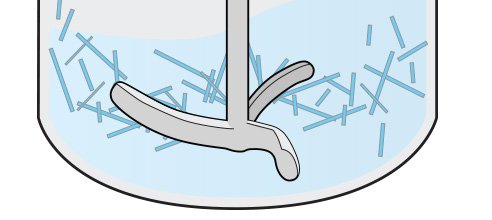
A ParticleTrack probe with FBRM technology is immersed into a flowing slurry or droplet system with no dilution necessary. A focused laser scans the surface of the probe window and tracks individual chord lengths - measurements of particle size, shape, and count. This real-time measurement is presented as a distribution and statistics (eg. mean, counts) are trended over time.
Technologies To Measure Crystal Size
Crystallization unit operations offer the unique opportunity to target and control an optimized crystal size and shape distribution. Doing so can dramatically reduce filtration and drying times, avoid storage, transport, and shelf life issues, and ensure a consistent and repeatable process at a lower cost.
Guide to Effective Process Development
This white paper series covers basic and advanced strategies to optimize crystal size and shape distribution.

Use Image Analysis To Optimize Crystallization
Discover how image-based process trending can reduce crystallization cycle time and improve quality while maintaining a similar crystal size and shape.

Seeding a Crystallization Process
This white paper discusses best practices for designing a seeding strategy and what parameters should be considered when implementing a seeding protocol. Although crystallization understanding has improved over the last thirty years, the seeding step still presents challenges.
應用
Particle Size, Shape, and Count Measurement To Improve Crystallization


Supersaturation Control Optimizes Crystal Size and Shape
Crystallization kinetics are characterized in terms of two dominant processes, nucleation kinetics and growth kinetics, occurring during crystallization from solution. Nucleation kinetics describe the rate of formation of a stable nuclei. Growth kinetics define the rate at which a stable nuclei grows to a macroscopic crystal. Advanced techniques offer temperature control to modify supersaturation and crystal size and shape.

Real-Time Monitoring for Modeling and Control
Continuous crystallization is made possible by advances in process modeling and crystallizer design, which leverage the ability to control crystal size distribution in real time by directly monitoring the crystal population.

如何透過溶劑添加控制晶體大小與數量
在反溶劑結晶過程中,溶劑的添加速率、添加位置及混合方式會影響容器或管道中的局部過飽和度。科學家和工程師透過調整反溶劑的添加程序及過飽和度水平,來改變晶體的大小與數量。

產生過飽和並確定最終晶體產品
一個設計良好的批次結晶 (Batch Crystallization) 過程,能夠成功放大至生產規模,並達到所需的晶體粒徑分布、產率、形態及純度。批次結晶的優化需要維持對結晶器溫度(或溶劑組成)的充分控制。

The Building Blocks of Crystallization
Solubility curves are commonly used to illustrate the relationship between solubility, temperature, and solvent type. By plotting temperature vs. solubility, scientists can create the framework needed to develop the desired crystallization process. Once an appropriate solvent is chosen, the solubility curve becomes a critical tool for the development of an effective crystallization process.

Recover Lactose with High Yield and Scalable Process
Lactose crystallization is an industrial practice to separate lactose from whey solutions via controlled crystallization.

設計和優化播種協議以提高批次一致性
播種是優化結晶行為最關鍵的步驟之一。在設計播種策略時,必須考慮種子大小、種子負荷(質量)和種子添加溫度等參數。這些參數通常根據製程動力學和所需的最終顆粒特性進行最佳化,並且在放大和技術轉讓期間必須保持一致。

Detect and Prevent Oiling Out (Liquid-Liquid Phase Separation)
Liquid-Liquid phase separation, or oiling out, is an often difficult to detect particle mechanism that can occur during crystallization processes.

Improve Crystallization with Inline Particle Size, Shape, and Count Measurement
In-process probe-based technologies are applied to track particle size and shape changes at full concentration with no dilution or extraction necessary. By tracking the rate and degree of change to particles and crystals in real time, the correct process parameters for crystallization performance can be optimized.

擴大攪拌、計量和結晶
改變結晶器中的比例或混合條件會直接影響結晶過程的動力學和最終晶體尺寸。對於冷卻和反溶劑系統來說,傳熱和傳質效應分別是考慮的重要因素,其中溫度或濃度梯度會在普遍的過飽和度水平中產生不均勻性。

Understand Polymorphism and the Impact of Process Parameters
Crystal polymorphism describes the ability of one chemical compound to crystallize in multiple unit cell configurations, which often show different physical properties.

從溶劑選擇到晶種策略的製程優化步驟
深入了解再結晶(Recrystallization)的關鍵七大步驟:從溶解度數據分析、亞穩區晶種添加,到最終的固液分離與乾燥。本指南協助研發人員掌握過飽和度控制技術,優化晶體粒徑分佈並提升產物純度,加速從實驗室開發到大規模生產的進程。
Crystallization kinetics are characterized in terms of two dominant processes, nucleation kinetics and growth kinetics, occurring during crystallization from solution. Nucleation kinetics describe the rate of formation of a stable nuclei. Growth kinetics define the rate at which a stable nuclei grows to a macroscopic crystal. Advanced techniques offer temperature control to modify supersaturation and crystal size and shape.
Solubility curves are commonly used to illustrate the relationship between solubility, temperature, and solvent type. By plotting temperature vs. solubility, scientists can create the framework needed to develop the desired crystallization process. Once an appropriate solvent is chosen, the solubility curve becomes a critical tool for the development of an effective crystallization process.


In-process probe-based technologies are applied to track particle size and shape changes at full concentration with no dilution or extraction necessary. By tracking the rate and degree of change to particles and crystals in real time, the correct process parameters for crystallization performance can be optimized.

公佈欄
Particle Size, Shape, and Count Measurement To Improve Crystallization
White Papers

By quickly identifying unnecessary hold times and determining how cooling rate influences crystal growth and nucleation, the cycle time for an interme...
Dynamic mechanisms key to understanding crystallization processes can now be observed with in-situ microscopy. A white paper explains how leading chem...
This white paper introduces you to the fundamentals of crystallization process development and provides guidance for the design of a high quality crys...
This white paper focuses on advanced crystallization methods, emphasizing in-process characterization of key crystallization parameters, including sup...
工業結晶工藝的優化可提高產量和純度,降低能耗和成本,並提高產品的一致性。
播種是優化結晶過程的關鍵步驟,可確保一致的過濾速率、產量、多晶型和粒徑分佈。具有反饋控制的高級播種可幫助科學家獲得最佳的播種條件。
Scale-up of crystallization is notoriously complicated and companies are under pressure to develop scalable crystallization processes faster - at lowe...
This white paper demonstrates the methodology chemists use to optimize critical crystallization parameters such as temperature profile, addition rates...
本白皮書討論了粒度分析,將傳統的離線方法與較新的在線技術進行了比較。過程中方法允許立即調整和優化過程。
Webinars
Eric Fang of Snapdragon discusses how continuous flow chemistry is applicable across the entire value chain. Early implementation of continuous flow...
This webinar introduces case studies and highlights best practices used to overcome crystallization and precipitation challenges. The focus will be on...
The webinar focuses on a semi-quantitative method for the optimization and scale-up of hydrodynamically limited anti-solvent crystallization process....
This webinar introduces case studies and highlights best practices used to overcome crystallization and precipitation challenges. The focus will be on...
Citations

Crystallization and precipitation citation list and publications
相關產品
Measure Particle Size, Shape and Count For Crystallization

粒徑分析儀
使用線上粒徑分析儀即時了解、最佳化和控制顆粒和液滴。

反應量熱儀 (Calorimeter)
反應量熱儀測量化學和製藥開發中化學或物理反應釋放或吸收的能量。

FTIR 紅外線光譜儀
原位 FTIR 光譜儀使科學家能夠深入了解其在廣泛應用中的反應和過程。使用線上 FTIR 儀器最佳化反應變數。