結晶開發指南
考慮製程規模
混合條件的影響
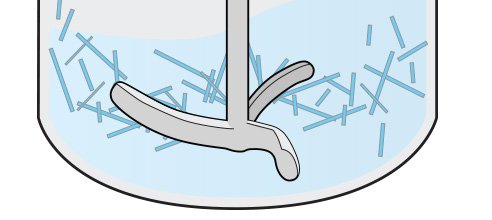
改變結晶器中的比例或混合條件會直接影響結晶過程的動力學和最終晶體尺寸。傳熱和傳質效應分別對於冷卻和反溶劑系統來說很重要,其中溫度或濃度梯度會在普遍的過飽和水平中產生不均勻性。這通常會導致靠近容器壁的過飽和度非常高的口袋以進行冷卻結晶,或在 反溶劑(以及反應性)結晶的添加位置出現非常高的過飽和度。
比較不同規模的混合
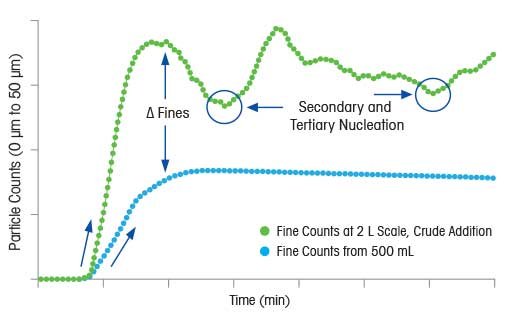
高過飽和度的口袋會導致大型結晶器的某些區域出現非常高的成核和生長率,這意味著最終的晶體尺寸分佈可能與開發過程中在實驗室中更好的混合環境中實現的分佈有很大差異。如右圖所示,在相同的結晶過程中,從 500 mL 反應器變更為 2 L 反應器會導致 ParticleTrack 所描述的意外成核事件。此外,整個批次產生的罰款數量也明顯更高。
結晶重複性
不同的成核動力學
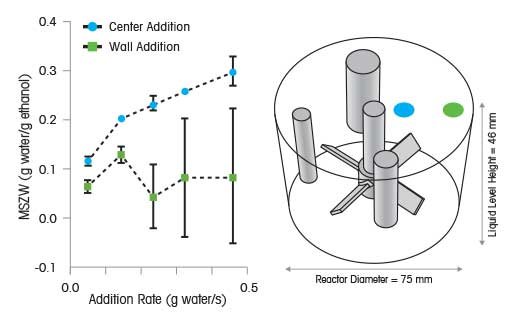
此處顯示了局部過飽和堆積對結晶的影響,其中顯示了反溶劑結晶系統的無種子結晶的成核點的可重複性。對於這個過程(右),當在液面上方和反應器壁附近添加反溶劑時,特別是在較高的添加速率下,成核點極不一致,這些實驗一式三份顯示出寬誤差線(D. O'Grady、M. Barrett、E. Casey 和 B. Glennon。(2007) 混合對苯甲酸反溶劑結晶中亞穩態區寬度和成核動力學的影響。化學工程研究與設計,85, 945 – 952)。此外,當在表面上方和結晶器壁上添加抗溶劑時,在較低的抗溶劑濃度下,成核總是更快發生。這兩個令人擔憂的結果的原因是,當抗溶劑在靠近壁邊添加時,結晶器中的混合條件使抗溶劑難以輕易摻入,並且進料位置會形成過飽和度。
抗溶劑加入
對結晶動力學的影響
一致性差異如此巨大的原因是由於抗溶劑如何摻入容器中。該視頻(左)展示了計算流體動力學 (CFD) 示踪劑實驗,適用於上面顯示的兩個加法位置(中心和牆壁)。當抗溶劑添加到表面以上並靠近牆壁時,很難有效地將液體摻入散裝溶液中。當反溶劑被添加到葉輪附近時,反溶劑會立即摻入。對於這種結晶系統,這種抗溶劑摻入的差異——以及通過容器的過飽和均勻性的相關差異——導致結晶過程的成核和一致性存在顯著差異。
混合對破損的影響
剪切速率
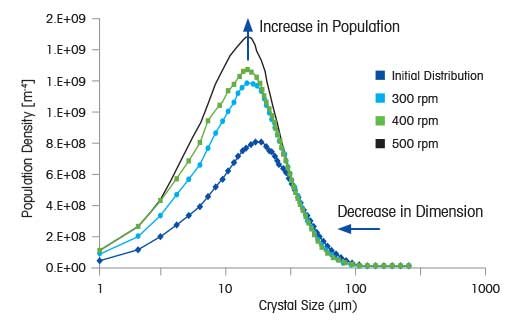
除了傳質效應外,結晶器中的剪切速率還會透過破碎對晶體產生物理影響。晶體破碎是系統中固體濃度和剪切速率的函數。隨著規模和混合條件的變化 - 固體濃度和剪切速率梯度可能變得很重要,這意味著隨著結晶過程的擴大,可能會發生或多或少的破損。在此示例(右)中, 顯示了使用 FBRM 技術 (ParticleTrack) 獲得的用於連續結晶過程的弦長分佈,適用於三種不同的攪拌強度(E. Kougoulos、AG Jones 和 MW Wood-Kaczmar (2005) 使用改良的連續冷卻混合懸浮混合產物去除 (MSMPR) 結晶器估計有機精細化學品的結晶動力學,晶體生長雜誌, 第 273 卷,第 3 – 4 期,2005 年 1 月 3 日,第 520 – 528 頁)。 隨著攪拌和相關剪切速率的增加,分佈隨著細晶體數量的增加而向左移動,表明晶體破碎。這個結果很常見。 然而,隨著體積的變化,這種行為很難預測,因為攪拌強度不是一個可擴展的參數。
用於製程優化的粒徑分析
本文討論了常見的粒徑分析技術以及如何使用它們來輸送高質量顆粒。例如,使用離線粒度分析儀與製程中顆粒表徵工具結合使用,以優化製程。
監控、優化和控制的技術
結晶裝置操作提供了獨特的機會來瞄準和控制優化的晶體尺寸和形狀分佈,以:
- 減少過濾和乾燥時間
- 避免儲存、運輸和保質期問題
- 以更低的成本確保流程一致且可重複
應用
透過溫度控制優化晶體尺寸和形狀的應用


Supersaturation Control Optimizes Crystal Size and Shape
Crystallization kinetics are characterized in terms of two dominant processes, nucleation kinetics and growth kinetics, occurring during crystallization from solution. Nucleation kinetics describe the rate of formation of a stable nuclei. Growth kinetics define the rate at which a stable nuclei grows to a macroscopic crystal. Advanced techniques offer temperature control to modify supersaturation and crystal size and shape.

Real-Time Monitoring for Modeling and Control
Continuous crystallization is made possible by advances in process modeling and crystallizer design, which leverage the ability to control crystal size distribution in real time by directly monitoring the crystal population.

如何透過溶劑添加控制晶體大小與數量
在反溶劑結晶過程中,溶劑的添加速率、添加位置及混合方式會影響容器或管道中的局部過飽和度。科學家和工程師透過調整反溶劑的添加程序及過飽和度水平,來改變晶體的大小與數量。

產生過飽和並確定最終晶體產品
一個設計良好的批次結晶 (Batch Crystallization) 過程,能夠成功放大至生產規模,並達到所需的晶體粒徑分布、產率、形態及純度。批次結晶的優化需要維持對結晶器溫度(或溶劑組成)的充分控制。

The Building Blocks of Crystallization
Solubility curves are commonly used to illustrate the relationship between solubility, temperature, and solvent type. By plotting temperature vs. solubility, scientists can create the framework needed to develop the desired crystallization process. Once an appropriate solvent is chosen, the solubility curve becomes a critical tool for the development of an effective crystallization process.

Recover Lactose with High Yield and Scalable Process
Lactose crystallization is an industrial practice to separate lactose from whey solutions via controlled crystallization.

設計和優化播種協議以提高批次一致性
播種是優化結晶行為最關鍵的步驟之一。在設計播種策略時,必須考慮種子大小、種子負荷(質量)和種子添加溫度等參數。這些參數通常根據製程動力學和所需的最終顆粒特性進行最佳化,並且在放大和技術轉讓期間必須保持一致。

Detect and Prevent Oiling Out (Liquid-Liquid Phase Separation)
Liquid-Liquid phase separation, or oiling out, is an often difficult to detect particle mechanism that can occur during crystallization processes.

Improve Crystallization with Inline Particle Size, Shape, and Count Measurement
In-process probe-based technologies are applied to track particle size and shape changes at full concentration with no dilution or extraction necessary. By tracking the rate and degree of change to particles and crystals in real time, the correct process parameters for crystallization performance can be optimized.

擴大攪拌、計量和結晶
改變結晶器中的比例或混合條件會直接影響結晶過程的動力學和最終晶體尺寸。對於冷卻和反溶劑系統來說,傳熱和傳質效應分別是考慮的重要因素,其中溫度或濃度梯度會在普遍的過飽和度水平中產生不均勻性。

Understand Polymorphism and the Impact of Process Parameters
Crystal polymorphism describes the ability of one chemical compound to crystallize in multiple unit cell configurations, which often show different physical properties.

從溶劑選擇到晶種策略的製程優化步驟
深入了解再結晶(Recrystallization)的關鍵七大步驟:從溶解度數據分析、亞穩區晶種添加,到最終的固液分離與乾燥。本指南協助研發人員掌握過飽和度控制技術,優化晶體粒徑分佈並提升產物純度,加速從實驗室開發到大規模生產的進程。
Crystallization kinetics are characterized in terms of two dominant processes, nucleation kinetics and growth kinetics, occurring during crystallization from solution. Nucleation kinetics describe the rate of formation of a stable nuclei. Growth kinetics define the rate at which a stable nuclei grows to a macroscopic crystal. Advanced techniques offer temperature control to modify supersaturation and crystal size and shape.
Solubility curves are commonly used to illustrate the relationship between solubility, temperature, and solvent type. By plotting temperature vs. solubility, scientists can create the framework needed to develop the desired crystallization process. Once an appropriate solvent is chosen, the solubility curve becomes a critical tool for the development of an effective crystallization process.


In-process probe-based technologies are applied to track particle size and shape changes at full concentration with no dilution or extraction necessary. By tracking the rate and degree of change to particles and crystals in real time, the correct process parameters for crystallization performance can be optimized.

公佈欄
結晶溫度控制出版物
白皮書

Dynamic mechanisms key to understanding crystallization processes can now be observed with in-situ microscopy. A white paper explains how leading chem...
This white paper introduces you to the fundamentals of crystallization process development and provides guidance for the design of a high quality crys...
This white paper focuses on advanced crystallization methods, emphasizing in-process characterization of key crystallization parameters, including sup...
工業結晶工藝的優化可提高產量和純度,降低能耗和成本,並提高產品的一致性。
播種是優化結晶過程的關鍵步驟,可確保一致的過濾速率、產量、多晶型和粒徑分佈。具有反饋控制的高級播種可幫助科學家獲得最佳的播種條件。
Scale-up of crystallization is notoriously complicated and companies are under pressure to develop scalable crystallization processes faster - at lowe...
This white paper demonstrates the methodology chemists use to optimize critical crystallization parameters such as temperature profile, addition rates...
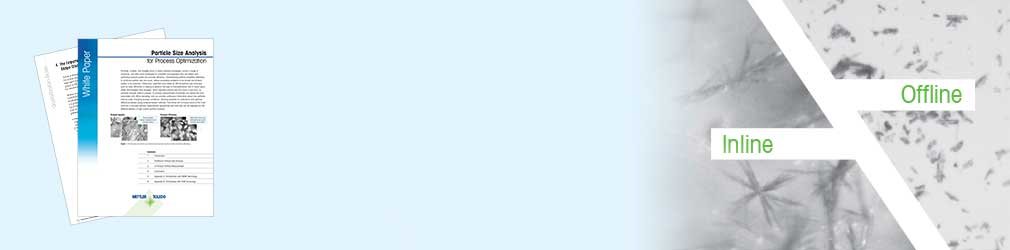
本白皮書討論了粒度分析,將傳統的離線方法與較新的在線技術進行了比較。過程中方法允許立即調整和優化過程。
網路研討會
Eric Fang of Snapdragon discusses how continuous flow chemistry is applicable across the entire value chain. Early implementation of continuous flow...
This webinar introduces case studies and highlights best practices used to overcome crystallization and precipitation challenges. The focus will be on...
The webinar focuses on a semi-quantitative method for the optimization and scale-up of hydrodynamically limited anti-solvent crystallization process....
This webinar introduces case studies and highlights best practices used to overcome crystallization and precipitation challenges. The focus will be on...
引文

Crystallization and precipitation citation list and publications