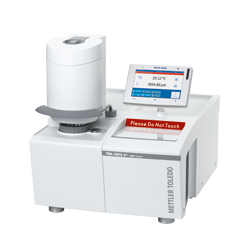
Live Webinar: Thermomechanical Analysis (TMA)
Learn Basic Principles, Measurement Modes, and Useful Applications for Your Workplace
نظرة عامة على البرنامج
- Basic principles of TMA
- Measurement modes (dilatometry, penetration, tension, swelling, dynamic load, bending)
- Why you should use TMA for your analysis
- Application examples for different industries
- Live Q&A with our experts
Thermomechanical analysis (TMA) is used to measure the dimensional changes, or deformation, of a sample as it is heated or cooled and subjected to a defined stress or load. It determines expansion, shrinking, and softening behavior on materials such as films, laminates, solids, and fibers. The technique is also very useful for measuring relaxation effects that are often not detected by DSC.
Register for our live webinar to learn all about this useful technique and discover real-life applications. Whether you are new to TMA or looking to strengthen your existing knowledge, this webinar offers valuable guidance from our experienced specialists.
The TMA Technique
In a typical TMA experiment, the sample is placed on the sample support and a constant load is applied via a measuring probe. The probe remains in contact with the sample and moves up or down as the sample expands or contracts with a change in temperature. The displacement of the probe is measured by means of a sensor. The sample set-up and applied load vary depending on the measurement mode and the information required.
Thermal expansion or shrinkage, as well as the deformation or stiffness of the material, can be determined based on the set-up and measured displacement. Typical properties of interest determined by TMA are the glass transition, coefficient of thermal expansion (CTE), and Young’s modulus.
TMA is a versatile technique that can be used to study a wide range of materials, including polymers, composites, ceramics, metals, and biomaterials. It is commonly used in material research, quality control, and failure analysis applications.
Join our live webinar to learn all about TMA and don’t miss the opportunity to ask our experts your questions!
Expert

Angela Hammer
Dr. sc. nat. ETH
Dr. Angela Hammer received a Ph.D. in Analytical Chemistry (development of immobilized components for the use in ion-selective electrodes based on polyurethane membranes) from the Institute of Organic Chemistry at the Swiss Federal Institute of Technology in Zürich, Switzerland. She then joined Sika Technology AG in Zurich, Switzerland, as an analytical chemist. In 2007, she joined METTLER TOLEDO and has worked there since as an application specialist for Thermal Analysis. In her present position, she uses, teaches, and supports DSC, TGA, TMA, and DMA instruments for the METTLER TOLEDO’s Materials Characterization Group located at the head office in Switzerland.