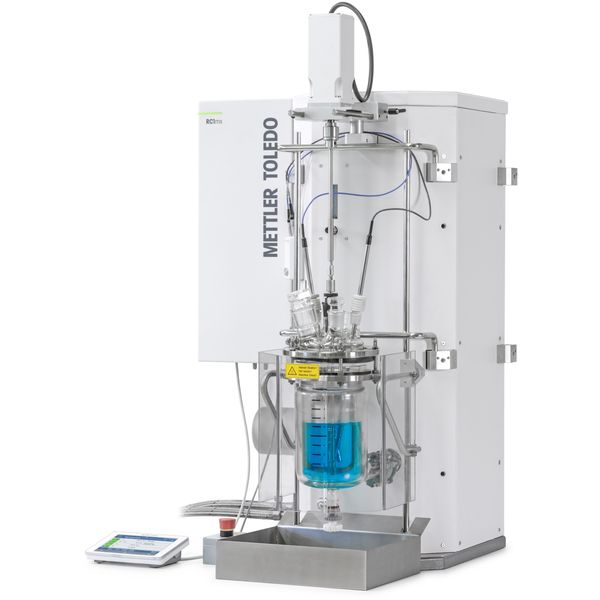
RC1mx is a cutting-edge reaction calorimeter designed for safety-focused process development. Its efficient thermostat safely handles rapid, intense exothermic events and provides precise heat of reaction data for effective hazard identification.
Please describe your project. /content/ca/en/home/products/L1_AutochemProducts/reaction-calorimeters/RC1mx-Reaction-Calorimeter.fb.1.c.11.html
Determine thermodynamic data quickly and precisely under isothermal or non-isothermal conditions
Heat Flow Calorimetry - Simply Reliable
Immune and robust against external influence, heat flow calorimetry accurately and precisely measures the evolution of heat under process conditions
Measuring the true heat of reaction
Measuring the "Complete" heat of reaction is the basis to understanding the progress of chemical reactions, their kinetics and hazard potential
Avoid incidents at scale-up
The safe and extremely powerful RC1mx thermostat can effectively cope with fast and strong exothermic events. It explores unknown process conditions without exposing operators or labs to any danger.
SmartConnect plug-and-play concept
The SmartConnect Technology allows the integration of third-party sensors as well as third-party actors (such as dosing pumps) in a plug-and-play fashion thanks to adjustment and configuration data stored on a chip in the sensor/actor cable plug.
RC1mx and HFCal: True heat of reaction
The complete system consists of the RC1mx (30405799) and HFCal option (30400340). The RC1mx HFCal option enables quick, precise and complete determination of thermodynamic information under all process conditions.
Specifications
009007002
Specifications - RC1mx and HFCal
Temperature Range
-70 °C – 300 °C
Professor Francis Stossel of the non-profit Swiss Institute for the Promotion of Safety and Security asks Is Is your process resistant towards maloperation? Is the cooling capacity sufficient to deal with the heat release rate of the reaction? Predicting the worst-case scenario is critical in order to speed development and avoid catastrophe in production. In his talk, Avoiding Incidents at Scale-up, Stossel uses RC1 reaction calorimetry data to evaluate critical thermodynamic information. The adiabatic temperature rise can easily be calculated by building the ratio between the heat of reaction and the heat capacity. Both values may be measured in a reaction calorimeter. So we also see that the temperature rise is proportional to the energy released and therefore may be used as a measure of the severity of an incident. Using this understanding, chemists and engineers can predict how an emergency would unfold in the case of a cooling failure, and redesign the process itself, with safety in mind. Using the RC one data, we can assess the severity, the probability of occurrence of secondary reactions, the criticality class and finding out what the weak points are to take measures against it. So how can you identify the criticality of a reaction and overcome weak points? The cooling failure scenario and the criticality classes allow assessing the thermal risks linked to a process. The RC1 data allow to choose and design the required safety measures, rendering processes robust against mal-operation. Learn more about the five questions that must be answered before chemical process is considered safe. Visit mt.com slash scaleup dash webinar.
The RC1mx reaction calorimeter is the leading technology for process safety. Accurate and comprehensive calorimetric data provides information needed...
METTLER TOLEDO provides a range of value-added service options to help ensure instrument uptime, provide quality results, and ensure regulatory compli...