Effects of poor sensor response, too high, fluctuating result values in end point (EP) and equivalence point (EQP) titration
The result values are too high or fluctuating in potentiometric EP and EQP titration. Furthermore no EQP is found and the endpoint is not attaining with EP titrations. What could be the reason?
Possible reasons:
The response time of the glass or metal ring sensor is too slow to follow the set titration parameters in the respective titration method.
Recommendations:
If the sensor has a slower response time from the time the method was programmed and developed for either end point or equivalence point titrations, one may get falsely high results. The slow responding sensor will not react fast enough to accurately plot and log the potential and an excess volume can be added before the information is accurate.
For pH sensors the ‘Sensor Check’ routine available in the titrator can be performed in order to receive unambiguous data whether the sensor is responding within expectations to potential change. Furthermore monitoring of titration times is a good measure to decide whether the sensor shall be renegerated or replaced.
If an end point titration is performed, it is critical that the titrant addition rate matches the response time of the sensor as well as the speed of the reaction. A new, fast responding sensor may follow a fast titrant addition. Over the time the performance of the sensor degrades, the response time slows down and the sensor may not measure the potential difference as quickly as determined by the fast titrant addition. As a result, too much titrant volume is added which results in a volume error and erroneously wrong results (cf. schematic titration curve illustration.
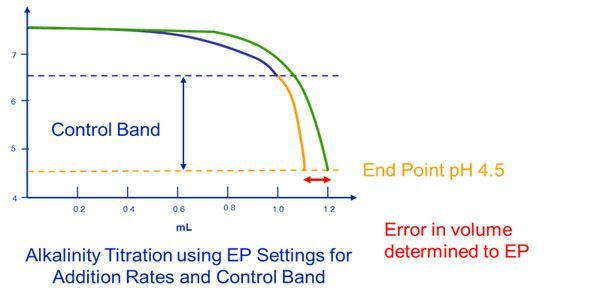
If an EQP titration is performed with
a. tight equilibrium measurement acquisition criteria, i.e. a stable potential reading (<0.1 mV) shall be achieved within a short time (< 1 sec)
b. tight fixed measurement acquisition time, i.e. <1 sec
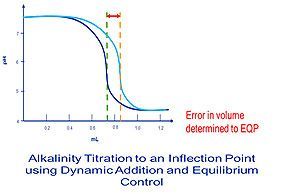
a slow responding sensor will not respond timely to the true potential change of the sample solution during titrant addition. This may cause falsely high results as the titrator continues to add titrant before the sensor can ‘catch up’ to the changing potential (cf. schematic curve illustration).
Placing a new sensor on the titrator and running the analysis again acts as a quick troubleshooting technique to see if a worn sensor is the cause of the results being too high.
© METTLER TOLEDO. All rights reserved.