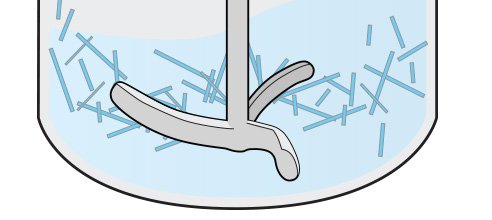
Guide to Crystallization Development

Avoiding Sampling and Offline Analysis
Obtaining a Representative Sample
Offline analysis is commonly used to determine crystal distribution at the end of an experiment or during a production run. While such an approach is common, there are limitations to offline analysis which are relevant for crystals:
- Crystals are delicate and change with temperature – making representative sampling and analysis particularly difficult
- Many crystal systems are toxic and do not lend themselves well to sampling
- It is difficult to take enough offline samples to determine how a fast changing process, such as crystallization, behaves with respect to time.
- The time delay between sampling and offline analysis is often too long, especially in production, to make relevant decisions that can improve product quality

Why Crystal Size and Shape Are Important
Improve the Product and Process
This set of ParticleView images neatly illustrates the complex size, shape, and structure of various crystals. From large round “boulders” to beautifully delicate “dendrites”, crystal product is often varied, posing challenges to effective separation and downstream manipulation.
- The crystals in Image A will likely filter quickly and consistently. The larger boulders will leave plenty of space for the filtrate to pass through rapidly.
- Flat plates like these in Image B can be some of the most difficult to filter. Plates tend to stack on top of each other creating a layer of crystals that the filtrate cannot get through. This leads to long and potentially variable filtration times, depending on how the crystals are discharged from the crystallizer.
- Image C illustrates another case where filtration times can be long. Small crystals will plug the gaps left by the larger crystals making it difficult for the filtrate to pass through the bed of crystals. This is a common problem because many crystallization processes are designed with a fast cool or anti-solvent addition step at the end of the crystallization (to increase yield) that leads to excessive secondary nucleation. Additionally, in many cases the agitation is increased at the end of the batch to help with discharge and this leads to crystal breakage.
- Image D is more common than many would expect, at least in organic crystallization systems that are seeded. A structure such as this would be difficult to observe using an offline microscope as it will be crushed during sampling and preparation. However, ParticleView reveals a beautiful dendritic structure. A dendrite such as this often forms when crystallization is seeded with milled seed. Imperfections on the crystal surface lead to crystal growth from these areas and long crystal branches growing from a seed core. It is difficult to predict how something like this will filter, but it is likely to break apart resulting in variable filtration times.
Real-Time Microscopy
By studying crystals in real time, scientists can develop detailed and reliable process understanding on a routine basis. ParticleView V19 with PVM technology allows scientists to directly observe crystals and crystal structures in process without having to take a sample.
Crystallization mechanisms such as nucleation, growth, breakage, and shape changes can be observed under dynamic changing process conditions and the most suitable process parameters can be chosen with confidence. A simple image-based trend that indicates how crystal size, shape, and count complements high resolution real time images and allows important process events to be identified and investigated immediately.

In-Process Particle Characterization
ParticleTrack with FBRM technology tracks the rate and degree of change to crystals and crystal structures as they naturally exist in process. A precise measurement, sensitive to changing crystal size, shape, and count, is provided in real time under dynamic changing process conditions at full process concentrations. This technique is applied as a standard tool during crystallization development and is a powerful process monitoring instrument in production, where it is used to troubleshoot difficult processes and ensure batch-to-batch consistency.
Using ParticleTrack, scientists can:
- Study crystal count in individual size classes – to optimize fine and coarse ends of the crystal size distribution
- Identify the root cause of a poorly performing crystallization process
- Choose the correct process parameters for optimal crystallization performance using process-based evidence
- Monitor processes for repeatability and consistency
- Correlate in-process measurements to offline particle size analysis
- Model the influence of crystal size and count on product and process quality

Focused Beam Reflectance Measurement (FBRM)
Inline Particle Size, Count, and Shape
A ParticleTrack probe with FBRM technology is immersed into a flowing slurry or droplet system with no dilution necessary. A focused laser scans the surface of the probe window and tracks individual chord lengths - measurements of particle size, shape, and count. This real-time measurement is presented as a distribution and statistics (eg. mean, counts) are trended over time.

Technologies To Measure Crystal Size
Crystallization unit operations offer the unique opportunity to target and control an optimized crystal size and shape distribution. Doing so can dramatically reduce filtration and drying times, avoid storage, transport, and shelf life issues, and ensure a consistent and repeatable process at a lower cost.
Guide to Effective Process Development
This white paper series covers basic and advanced strategies to optimize crystal size and shape distribution.

Use Image Analysis To Optimize Crystallization
Discover how image-based process trending can reduce crystallization cycle time and improve quality while maintaining a similar crystal size and shape.

Seeding a Crystallization Process
This white paper discusses best practices for designing a seeding strategy and what parameters should be considered when implementing a seeding protocol. Although crystallization understanding has improved over the last thirty years, the seeding step still presents challenges.
Aplikasyonlar
Particle Size, Shape, and Count Measurement To Improve Crystallization


Supersaturation Control Optimizes Crystal Size and Shape
Crystallization kinetics are characterized in terms of two dominant processes, nucleation kinetics and growth kinetics, occurring during crystallization from solution. Nucleation kinetics describe the rate of formation of a stable nuclei. Growth kinetics define the rate at which a stable nuclei grows to a macroscopic crystal. Advanced techniques offer temperature control to modify supersaturation and crystal size and shape.

Real-Time Monitoring for Modeling and Control
Continuous crystallization is made possible by advances in process modeling and crystallizer design, which leverage the ability to control crystal size distribution in real time by directly monitoring the crystal population.

How Solvent Addition Can Control Crystal Size and Count
In an antisolvent crystallization, the solvent addition rate, addition location and mixing impact local supersaturation in a vessel or pipeline. Scientists and engineers modify crystal size and count by adjusting antisolvent addition protocols and the level of supersaturation.

Generate Supersaturation and Determine Final Crystal Product
A well-designed batch crystallization process is one that can be scaled successfully to production scale - giving the desired crystal size distribution, yield, form and purity. Batch crystallization optimization requires maintaining adequate control of the crystallizer temperature (or solvent composition).

The Building Blocks of Crystallization
Solubility curves are commonly used to illustrate the relationship between solubility, temperature, and solvent type. By plotting temperature vs. solubility, scientists can create the framework needed to develop the desired crystallization process. Once an appropriate solvent is chosen, the solubility curve becomes a critical tool for the development of an effective crystallization process.

Recover Lactose with High Yield and Scalable Process
Lactose crystallization is an industrial practice to separate lactose from whey solutions via controlled crystallization.

Karmaşık Makromoleküller İçin Yapılandırılmış, Düzenli Kafesler Oluşturun
Protein kristalleşmesi, genellikle karmaşık makromoleküller için yapılandırılmış, düzenli kafesler oluşturma eylemi ve yöntemidir.

İyileştirilmiş Grup Tutarlılığı İçin Tohumlama Protokolünü Tasarlama ve Optimize Etme
İyileştirilmiş Grup Tutarlılığı İçin Tohumlama Protokolünü Tasarlama ve Optimize Etme

Detect and Prevent Oiling Out (Liquid-Liquid Phase Separation)
Liquid-Liquid phase separation, or oiling out, is an often difficult to detect particle mechanism that can occur during crystallization processes.

Improve Crystallization with Inline Particle Size, Shape, and Count Measurement
In-process probe-based technologies are applied to track particle size and shape changes at full concentration with no dilution or extraction necessary. By tracking the rate and degree of change to particles and crystals in real time, the correct process parameters for crystallization performance can be optimized.

Ajitasyon, dozlama ve kristalizasyonun ölçeklendirilmesi
Bir kristalizatördeki ölçeğin veya karıştırma koşullarının değiştirilmesi, kristalizasyon işleminin kinetiğini ve nihai kristal boyutunu doğrudan etkileyebilir. Isı ve kütle transferi etkilerinin, sıcaklık veya konsantrasyon gradyanlarının hakim aşırı doygunluk seviyesinde homojenlik üretebildiği soğutma ve antisolvent sistemleri için dikkate alınması önemlidir.

Understand Polymorphism and the Impact of Process Parameters
Crystal polymorphism describes the ability of one chemical compound to crystallize in multiple unit cell configurations, which often show different physical properties.

Kristalleşmenin İtici Gücü
Aşırı doygunluk, bir çözeltinin sistem koşulları göz önüne alındığında termodinamik olarak mümkün olması gerekenin üzerinde çözünen madde içermesi durumunda ortaya çıkar. Aşırı doygunluk, kristalleşmenin başlıca itici gücü olarak kabul edilir.

Optimization of Crystal Properties and Process Performance
Recrystallization is a technique used to purify solid compounds by dissolving them in a hot solvent and allowing the solution to cool. During this process, the compound forms pure crystals as the solvent cools, while impurities are excluded. The crystals are then collected, washed, and dried, resulting in a purified solid product. Recrystallization is an essential method for achieving high levels of purity in solid compounds.

Kristalleşme Deneylerini Hassas Kontrol ile İyileştirin
MSMPR (Karışık Süspansiyon Karışık Ürün Çıkarma) kristalizatörü, endüstriyel işlemlerde yüksek saflıkta kristaller üretmek için kullanılan bir kristalizatör türüdür.
Crystallization kinetics are characterized in terms of two dominant processes, nucleation kinetics and growth kinetics, occurring during crystallization from solution. Nucleation kinetics describe the rate of formation of a stable nuclei. Growth kinetics define the rate at which a stable nuclei grows to a macroscopic crystal. Advanced techniques offer temperature control to modify supersaturation and crystal size and shape.
A well-designed batch crystallization process is one that can be scaled successfully to production scale - giving the desired crystal size distribution, yield, form and purity. Batch crystallization optimization requires maintaining adequate control of the crystallizer temperature (or solvent composition).
Solubility curves are commonly used to illustrate the relationship between solubility, temperature, and solvent type. By plotting temperature vs. solubility, scientists can create the framework needed to develop the desired crystallization process. Once an appropriate solvent is chosen, the solubility curve becomes a critical tool for the development of an effective crystallization process.
In-process probe-based technologies are applied to track particle size and shape changes at full concentration with no dilution or extraction necessary. By tracking the rate and degree of change to particles and crystals in real time, the correct process parameters for crystallization performance can be optimized.
Bir kristalizatördeki ölçeğin veya karıştırma koşullarının değiştirilmesi, kristalizasyon işleminin kinetiğini ve nihai kristal boyutunu doğrudan etkileyebilir. Isı ve kütle transferi etkilerinin, sıcaklık veya konsantrasyon gradyanlarının hakim aşırı doygunluk seviyesinde homojenlik üretebildiği soğutma ve antisolvent sistemleri için dikkate alınması önemlidir.
Recrystallization is a technique used to purify solid compounds by dissolving them in a hot solvent and allowing the solution to cool. During this process, the compound forms pure crystals as the solvent cools, while impurities are excluded. The crystals are then collected, washed, and dried, resulting in a purified solid product. Recrystallization is an essential method for achieving high levels of purity in solid compounds.
Yayınlar
Particle Size, Shape, and Count Measurement To Improve Crystallization
White Papers

By quickly identifying unnecessary hold times and determining how cooling rate influences crystal growth and nucleation, the cycle time for an interme...
Kristalleşme işlemlerini anlamanın anahtarı olan dinamik mekanizmalar şimdi doğal durum mikroskobuyla gözlemlenebilir. Bir rapor, önde gelen kimya şir...
Kristalleşme prosesinin kalitesi, nihai ürünün kalitesini büyük oranda etkiler. Yeni teknik dokümanımız, kristalleşmenin temellerini anlatır ve yüksek...
Farmasötik ve yüksek değerli kimyasal maddeler için geliştirme ve üretim aşamasında çoğu zaman çeşitli kristalleştirme adımları uygulanması gerekir...
Endüstriyel kristalleşme, kimya endüstrisinde önemli bir ayrıma ve arındırma adımıdır. Ürün kalitesini ve verimi artırmak üzere kristalleşmeyi anlama...
Tohumlama, kristalizasyon prosesini optimize etmede, tutarlı bir filtrasyon hızı, verim, polimorfik form ve partikül boyutu dağılımı sağlamada önemli...
Scale-up of crystallization is notoriously complicated and companies are under pressure to develop scalable crystallization processes faster - at lowe...
This white paper demonstrates the methodology chemists use to optimize critical crystallization parameters such as temperature profile, addition rates...
Bu teknik dokümanda, geleneksel çevrimdışı yöntemler ile daha yeni proses içi teknikler karşılaştırılarak partikül boyutu analizi ele alınmaktadır. Pr...
Webinars
Eric Fang of Snapdragon discusses how continuous flow chemistry is applicable across the entire value chain. Early implementation of continuous flow...
This webinar introduces case studies and highlights best practices used to overcome crystallization and precipitation challenges. The focus will be on...
The webinar focuses on a semi-quantitative method for the optimization and scale-up of hydrodynamically limited anti-solvent crystallization process....
This webinar introduces case studies and highlights best practices used to overcome crystallization and precipitation challenges. The focus will be on...
Citations

Crystallization and precipitation citation list and publications
İlgili Ürünler
Measure Particle Size, Shape and Count For Crystallization

Partikül Boyutu Analizörleri
Online partikül boyutu analizörleri ile partikül ve damlacıkları anlayın, gerçek zamanlı olarak optimize edin ve kontrol altına alın.

Reaksiyon Kalorimetreleri
Reaksiyon kalorimetreleri, kimyasal ve farmasötik geliştirmede kimyasal veya fiziksel bir reaksiyon tarafından salınan veya emilen enerji miktarını ölçer.

ReactIR
Online FTIR spektrometreleri, bilim insanlarının çok çeşitli uygulamalardaki reaksiyonları ve prosesleri hakkında fikir edinmelerini sağlar. Hat içi FTIR cihazlarıyla reaksiyon değ...