Guide to Crystallization Development
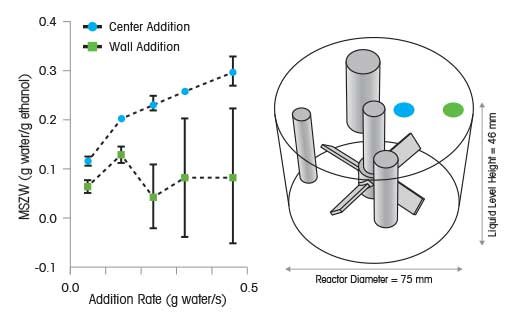
In this short video, I would like to introduce one of the ways that mixing can influence crystallization processes. For this study, an anti-solvent crystallization process was characterized. Specifically, this is the crystallization of benzoic acid from ethanol water solutions using water as the anti-solvent itself. And one of the original goals of this study was to really try and map a design space and develop a seeding strategy for this crystallization process. The crystallizer configuration is shown on the right-hand side here, and we can see we're actually studying this crystallization using a number of analytical techniques, including ReactIR and Particle Track. One of the things that became apparent very early in the characterization of this process was the influence of the addition rate of anti-solvent on the metastable zone width. Typically what one would expect for a Classical crystallization is that as the addition rate increases and the rate of supersaturation generation increases, the metastable zone width would get wider. But for this system, we actually did not see that occurring. What in fact we saw is that there was very little variation in the metastable zone width as the addition rate increased. And what we also observed is that the consistency of the metastable zone width measured deteriorated significantly at higher addition rates. And what that means for this process is that it becomes very difficult to seed the process because what can potentially happen is the crystals begin to nucleate at times that cannot be predicted, meaning the seed may be added after the crystals have already nucleated. It means the process is not going to be repeatable, and we could result in purity and particle size distribution issues. So based on this result of an initial characterization, the question was posed, how can this be scaled up? How can a seeding strategy be implemented? And can we model this behavior? So, one way to look at anti-solvent addition crystallizations is from the mixing perspective, and it's beyond the scope of this video to get into a huge amount of detail around the theory of mixing for crystallization processes, but I have outlined a number of really seminal papers in this area which go into great detail on how crystallization processes. can be modeled from a mixing perspective. But essentially, at a very high level overview, there's three different types of mixing that need to be considered for crystallization. The first would be macro mixing at the kind of bulk level of the crystallizer itself. The second would be the meso mixing time scale, which is at the frame of reference around where the anti-solvent is added, essentially the plume of anti-solvent that gets added to the bulk solution. And then finally, the micro mixing, which is at a much smaller scale. For anti-solvent addition crystallization, the hypothesis we made was that really this meso-mixing timescale would be important for this crystallization process because it's really at the scale where the anti-solvent gets added to the bulk solution. So the question became could we use CFD, computational fluid dynamics, to try and understand meso-mixing timescales for our system. And one way this can be kind of neatly represented is to actually look at the crystallization of benzoic acid by adding water as an anti-solvent to ethanol water solutions. And what we can see here is that as we add water to the saturated solution, crystallization occurs pretty immediately in this case. Then what we did is a second experiment where we repeated the essentially the exact same experiment where we're adding the same amount of water at the same rate to the same saturated solution, but instead of adding it through a pipe with a very wide diameter, we essentially use a narrow diameter pipe and the water gets jetted into the solution. And in this case, what we actually see is no crystallization occurring in the second case. What we're actually seeing here is actually bubbles forming as the jet goes in, but they soon float to the top and no actual crystals come out of solution in this case. So even though we're doing the exact same thing to this process, the only change we're making is the diameter of the addition pipe. It's this meso mixing that is really affecting our crystallization process and whether it crystallizes or not. So, this behavior can be modeled using computational fluid dynamics. And what we can see here is that we model the behavior of our crystallization process by doing tracer experiments that show the anti-solvent being incorporated into our crystallizer. And this is where the anti-solvent, just like for our experiments that we showed earlier, is added close to the wall of the crystallizer. Now, using these computational fluid dynamic models, we can actually calculate the various mixing timescales, and the one we want to focus on here is one of these meso-mixing timescales, and what we're going to try and do is see if these meso-mixing timescales actually predict our crystallization performance. So we know that we have a consistent crystallization process at these low addition rates, and then we know we have a very inconsistent crystallization process at these very high addition rates. This is where the error bars for these measurements really begin to increase. So what we tried to do was correlate this to the mesomixing timescale. What we could say is that below a certain mesomixing timescale, our crystallization was consistent, And above a certain mesomixing timescale, our crystallization was inconsistent for this specific model condition. So what we've been able to determine is actually a threshold for premature nucleation or inconsistent nucleation that's associated with this mesomixing timescale from a purely theoretical perspective, but also combined with this experimental result from our initial characterization. So now what we can do is we can run these computational fluid dynamic models under a different set of experimental conditions. So instead of adding our anti-solvents close to the wall, in this model on the right-hand side, we're adding our anti-solvent close to the impeller shaft. And what we believe is that we can guarantee much faster anti-solvent incorporation by adding our anti-solvent close to the impeller because this is a downward pumping impeller that will pull the anti-solvent in much quicker. And now what we can do is again calculate these meso-mixing timescales, and what we observe is that by adding our anti-solvent close to the impeller shaft, we can bring the meso-mixing timescale much, much lower for every single addition rate that we might want to choose, and it is below this threshold for premature nucleation. So from here, it was a simple case of repeating our experiments, but instead of adding anti-solvent at the wall of our vessel, For these experiments, we added anti-solvent at the center of the vessel close to the impeller shaft, and what you can really begin to see now is a much more consistent behavior of this crystallization process, one that's much more predictable and much more in line with what one would expect from classical theory. So as we increase our addition rate, you can see the metastable zone width is getting wider, and also these error bars are much less dramatic at these higher addition rates. So we've gone from a case where we have a highly unpredictable, inconsistent crystallization process at a wide range of anti-solvent addition rates to one where it is highly consistent across all addition rates. And really this is only the result of changing our addition location for this crystallization process by a very small amount from the wall of the crystallizer to the center of the crystallizer. That's all that's really changed here. But this modeling that we've done has really helped us confirm that this change would work and also gives us some insight into alternative anti-solvent addition strategies that we could implement to try and control our crystallization further. So briefly, some acknowledgments. I'd really like to thank my former colleague at University College Dublin, Mark Barrish. We highly collaborated on this work and he did a lot of the computational fluid dynamic modeling. And there's two nice papers which have been published in this area which go into a lot more detail beyond what we can do in the scope of this short video. And if anyone is interested, I'd encourage them to check them out. Thank you.
Considering Process Scale
Influences of Mixing Conditions
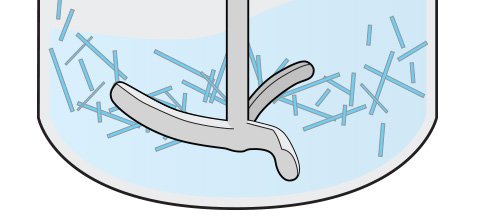
Changing the scale or mixing conditions in a crystallizer can directly impact the kinetics of the crystallization process and the final crystal size. Heat and mass transfer effects are important to consider for cooling and anti-solvent systems respectively, where temperature or concentration gradients can produce inhomogeneity in the prevailing level of supersaturation. This often results in pockets of very high supersaturation close to the walls of the vessel for a cooling crystallization, or at the addition location for anti-solvent (and also reactive) crystallizations.
Comparing Mixing at Different Scales
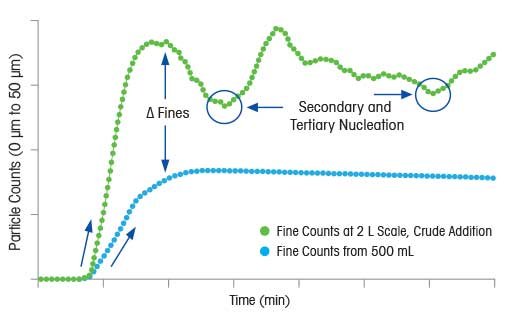
Pockets of high supersaturation can cause very high nucleation and growth rates in certain regions of a large scale crystallizer, meaning the final crystal size distribution could vary dramatically from that achieved in a better-mixed environment in the lab during development. As seen in the graph to the right, a change from a 500 mL reactor to a 2 L reactor for the same crystallization process results in unexpected nucleation events characterized by ParticleTrack. Also, the number of fines generated throughout the batch is significantly higher.
Crystallization Repeatability
Varying Nucleation Kinetics
The effect of local supersaturation build-up on crystallization is shown here, where the repeatability of the nucleation point for an unseeded crystallization is shown for an anti-solvent crystallization system. For this process (right), when anti-solvent is added above the liquid surface and near the wall of the reactor, especially at higher addition rates, the nucleation point is extremely inconsistent, with wide error bars shown for these experiments that were conducted in triplicate (D. O’Grady, M. Barrett, E. Casey, and B. Glennon. (2007) The Effect of Mixing on the Metastable Zone Width and Nucleation Kinetics in the Anti-solvent Crystallization of Benzoic Acid. Chemical Engineering Research and Design, 85, 945 – 952). Additionally, when adding anti-solvent above surface and at the wall of the crystallizer, nucleation consistently occurs sooner, at lower anti-solvent concentrations. The reason for these two concerning results is that when anti-solvent is added close to the wall, the mixing conditions in the crystallizer make it difficult for the anti-solvent to be incorporated easily, and supersaturation builds up at the feed location.
Anti-Solvent Incorporation
The Effect on Crystallization Kinetics
The reason for this dramatic disparity in consistency is due to how anti-solvent is incorporated into the vessel. This video (left) show computational fluid dynamics (CFD) tracer experiments, for both addition locations shown above (center and wall). When anti-solvent is added above the surface and close to the wall, it is difficult to effectively incorporate the liquid into the bulk solution. When anti-solvent is added closer to the impeller, incorporation of the anti-solvent occurs immediately. For this crystallization system this difference in anti-solvent incorporation – and the associated difference in the homogeneity of supersaturation through the vessel – causes significant differences in the nucleation and consistency of the crystallization process .
Effect of Mixing on Breakage
Shear Rates
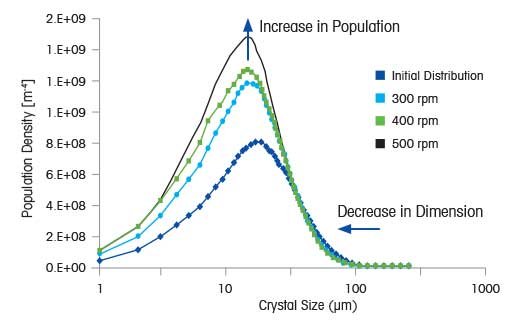
In addition to mass transfer effects, the shear rate in a crystallizer can have a physical impact on the crystals through breakage. Crystal breakage is a function of the solids concentration in the system as well as the shear rate. As scale and mixing conditions change - solids concentration and shear rate gradients may become important, meaning more or less breakage could occur as a crystallization process is scaled up. In this example (right), the chord length distributions acquired using FBRM technology (ParticleTrack) for a continuous crystallization process, are shown for three different agitation intensities (E. Kougoulos, A.G. Jones, and M.W. Wood-Kaczmar (2005) Estimation of Crystallization Kinetics for an Organic Fine Chemical Using a Modified Continuous Cooling Mixed Suspension Mixed Product Removal (MSMPR) Crystallizer, Journal of Crystal Growth, Volume 273, Issues 3 – 4, 3 January 2005, Pages 520 – 528). As agitation and the associated shear rate increase, the distributions shift to the left with an increase in fine crystal counts, indicating crystal breakage. This result is common. However, such behavior is difficult to predict as the volume changes, since agitation intensity is not a scalable parameter.
Particle Size Analysis for Process Optimization
This paper discusses common particle size analysis techniques and how they are used for the delivery of high-quality particles. Examples include the usage of offline particle size analyzers in combination with in-process particle characterization tools to optimize processes.
Technologies to Monitor, Optimize, and Control
Crystallization unit operations offer the unique opportunity to target and control an optimized crystal size and shape distribution to:
- Reduce Filtration and Drying Times
- Avoid Storage, Transport and Shelf Life Issues
- Ensure a Consistent and Repeatable Process at Lower Costs
Applications
Applications For Optimizing Crystal Size and Shape with Temperature Control


Optimization of Crystal Properties and Process Performance
Recrystallization is a technique used to purify solid compounds by dissolving them in a hot solvent and allowing the solution to cool. During this process, the compound forms pure crystals as the solvent cools, while impurities are excluded. The crystals are then collected, washed, and dried, resulting in a purified solid product. Recrystallization is an essential method for achieving high levels of purity in solid compounds.

The Building Blocks of Crystallization
Solubility curves are commonly used to illustrate the relationship between solubility, temperature, and solvent type. By plotting temperature vs. solubility, scientists can create the framework needed to develop the desired crystallization process. Once an appropriate solvent is chosen, the solubility curve becomes a critical tool for the development of an effective crystallization process.

The Driving Force for Crystallization
Supersaturation occurs when a solution contains more solute than should be possible thermodynamically, given the conditions of the system. Supersaturation is considered a major driver for crystallization.

Improve Crystallization with Inline Particle Size, Shape, and Count Measurement
In-process probe-based technologies are applied to track particle size and shape changes at full concentration with no dilution or extraction necessary. By tracking the rate and degree of change to particles and crystals in real time, the correct process parameters for crystallization performance can be optimized.

Design and Optimize Seeding Protocol for Improved Batch Consistency
Seeding is one of the most critical steps in optimizing crystallization behavior. When designing a seeding strategy, parameters such as seed size, seed loading (mass), and seed addition temperature must be considered. These parameters are generally optimized based on process kinetics and the desired final particle properties, and must remain consistent during scale-up and technology transfer.

Detect and Prevent Oiling Out (Liquid-Liquid Phase Separation)
Liquid-Liquid phase separation, or oiling out, is an often difficult to detect particle mechanism that can occur during crystallization processes.

How Solvent Addition Can Control Crystal Size and Count
In an antisolvent crystallization, the solvent addition rate, addition location and mixing impact local supersaturation in a vessel or pipeline. Scientists and engineers modify crystal size and count by adjusting antisolvent addition protocols and the level of supersaturation.

Supersaturation Control Optimizes Crystal Size and Shape
Crystallization kinetics are characterized in terms of two dominant processes, nucleation kinetics and growth kinetics, occurring during crystallization from solution. Nucleation kinetics describe the rate of formation of a stable nuclei. Growth kinetics define the rate at which a stable nuclei grows to a macroscopic crystal. Advanced techniques offer temperature control to modify supersaturation and crystal size and shape.

Scaling Up Agitation, Dosing, and Crystallization
Changing the scale or mixing conditions in a crystallizer can directly impact the kinetics of the crystallization process and the final crystal size. Heat and mass transfer effects are important to consider for cooling and antisolvent systems respectively, where temperature or concentration gradients can produce inhomogeneity in the prevailing level of supersaturation.

Understand Polymorphism and the Impact of Process Parameters
Crystal polymorphism describes the ability of one chemical compound to crystallize in multiple unit cell configurations, which often show different physical properties.

Create Structured, Ordered Lattices for Complex Macromolecules
Protein crystallization is the act and method of creating structured, ordered lattices for often-complex macromolecules.

Recover Lactose with High Yield and Scalable Process
Lactose crystallization is an industrial practice to separate lactose from whey solutions via controlled crystallization.

Improve Crystallization Experiments with Precise Control
The MSMPR (Mixed Suspension Mixed Product Removal) crystallizer is a type of crystallizer used in industrial processes to produce high-purity crystals.

Generate Supersaturation and Determine Final Crystal Product
A well-designed batch crystallization process is one that can be scaled successfully to production scale - giving the desired crystal size distribution, yield, form and purity. Batch crystallization optimization requires maintaining adequate control of the crystallizer temperature (or solvent composition).

Real-Time Monitoring for Modeling and Control
Continuous crystallization is made possible by advances in process modeling and crystallizer design, which leverage the ability to control crystal size distribution in real time by directly monitoring the crystal population.
Recrystallization is a technique used to purify solid compounds by dissolving them in a hot solvent and allowing the solution to cool. During this process, the compound forms pure crystals as the solvent cools, while impurities are excluded. The crystals are then collected, washed, and dried, resulting in a purified solid product. Recrystallization is an essential method for achieving high levels of purity in solid compounds.
Solubility curves are commonly used to illustrate the relationship between solubility, temperature, and solvent type. By plotting temperature vs. solubility, scientists can create the framework needed to develop the desired crystallization process. Once an appropriate solvent is chosen, the solubility curve becomes a critical tool for the development of an effective crystallization process.
In-process probe-based technologies are applied to track particle size and shape changes at full concentration with no dilution or extraction necessary. By tracking the rate and degree of change to particles and crystals in real time, the correct process parameters for crystallization performance can be optimized.
Seeding is one of the most critical steps in optimizing crystallization behavior. When designing a seeding strategy, parameters such as seed size, seed loading (mass), and seed addition temperature must be considered. These parameters are generally optimized based on process kinetics and the desired final particle properties, and must remain consistent during scale-up and technology transfer.
Crystallization kinetics are characterized in terms of two dominant processes, nucleation kinetics and growth kinetics, occurring during crystallization from solution. Nucleation kinetics describe the rate of formation of a stable nuclei. Growth kinetics define the rate at which a stable nuclei grows to a macroscopic crystal. Advanced techniques offer temperature control to modify supersaturation and crystal size and shape.
Changing the scale or mixing conditions in a crystallizer can directly impact the kinetics of the crystallization process and the final crystal size. Heat and mass transfer effects are important to consider for cooling and antisolvent systems respectively, where temperature or concentration gradients can produce inhomogeneity in the prevailing level of supersaturation.
A well-designed batch crystallization process is one that can be scaled successfully to production scale - giving the desired crystal size distribution, yield, form and purity. Batch crystallization optimization requires maintaining adequate control of the crystallizer temperature (or solvent composition).
Publications
Publications on Crystallization Temperature Control
White Papers

Dynamic mechanisms key to understanding crystallization processes can now be observed with in-situ microscopy. A white paper explains how leading chem...
This white paper introduces you to the fundamentals of crystallization process development and provides guidance for the design of a high quality crys...
This white paper focuses on advanced crystallization methods, emphasizing in-process characterization of key crystallization parameters, including sup...
Optimization of the industrial crystallization process leads to increased yield and purity, reduced energy consumption and cost, and improved product...
Seeding is a key step in optimizing a crystallization process, ensuring a consistent filtration rate, yield, polymorphic form and particle size distri...
Scale-up of crystallization is notoriously complicated and companies are under pressure to develop scalable crystallization processes faster - at lowe...
This white paper demonstrates the methodology chemists use to optimize critical crystallization parameters such as temperature profile, addition rates...
This white paper compares traditional offline particle characterization methods with newer in-process techniques for applications such as crystallizat...
Webinars
Eric Fang of Snapdragon discusses how continuous flow chemistry is applicable across the entire value chain. Early implementation of continuous flow...
This webinar introduces case studies and highlights best practices used to overcome crystallization and precipitation challenges. The focus will be on...
The webinar focuses on a semi-quantitative method for the optimization and scale-up of hydrodynamically limited anti-solvent crystallization process....
This webinar introduces case studies and highlights best practices used to overcome crystallization and precipitation challenges. The focus will be on...
Citations

Crystallization and precipitation citation list and publications
Related Products
Technology For Crystallization Temperature Control

ReactIR
In-situ FTIR spectrometers enable scientists to gain insight into their reactions and processes in a wide range of applications. Optimize reaction variables with inline FTIR instru...

Particle Size Analyzers
Understand, optimize, and control particles and droplets in real time with inline particle size analyzers.

Reaction Calorimeters
Reaction calorimeters measure the amount of energy released or absorbed by a chemical or physical reaction in chemical and pharmaceutical development.