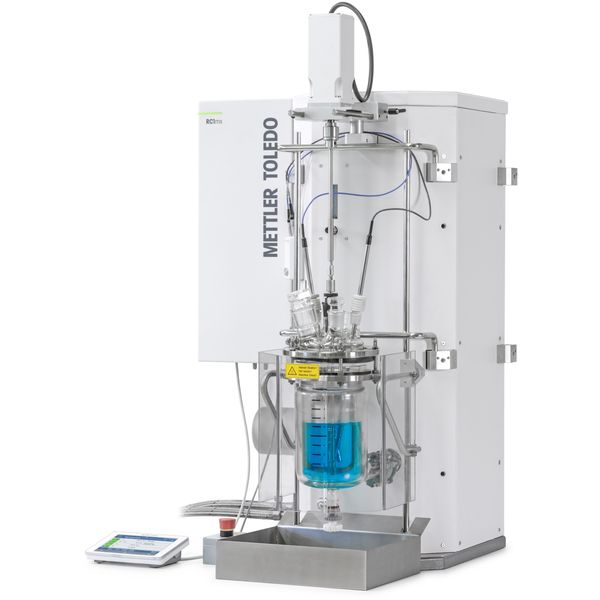
A reaction calorimeter is a tool used by scientists in chemical and pharmaceutical development to measure the amount of energy released or absorbed by a chemical or physical reaction.
It typically consists of a stirred tank reactor of variable size in which the temperature of the reaction mass is monitored and precisely controlled, together with all relevant critical process parameters.
Reaction calorimeters allow the investigation of chemical processes under process-like conditions, providing a full set of information about the scalability and safety of the process.
Depending on the stage of development, additional information might also be relevant. Thus, complementary data (e.g. analytical data from Infrared, Raman, HPLC, or similar) may be collected and integrated with the heat flow data.
Профессор Фрэнсис Стоссел из некоммерческого Швейцарского института содействия безопасности и защищенности задает вопрос: устойчив ли ваш процесс к ошибкам эксплуатации? Достаточна ли охлаждающая способность, чтобы справиться со скоростью выделения тепла реакции? Прогнозирование наихудшего сценария имеет решающее значение, чтобы ускорить разработку и избежать катастрофы в производстве. В своем докладе «Избегая инцидентов при масштабировании» Стоссел использует данные RC1 по реакционной калориметрии для оценки критически важной термодинамической информации. Адиабатический рост температуры можно легко рассчитать, взяв отношение тепловыделения реакции к теплоемкости. Оба значения можно измерить в реакционном калориметре. Таким образом, мы также видим, что рост температуры пропорционален выделившейся энергии и, следовательно, может использоваться как мера тяжести инцидента. Используя это понимание, химики и инженеры могут предсказать, как будет развиваться аварийная ситуация в случае отказа системы охлаждения, и переработать сам процесс с учетом безопасности. Используя данные RC one, мы можем оценить тяжесть, вероятность возникновения побочных реакций, класс критичности и выявить слабые места, чтобы принять меры по их устранению. Итак, как определить критичность реакции и устранить слабые места? Сценарий отказа охлаждения и классы критичности позволяют оценить тепловые риски, связанные с процессом. Данные RC1 позволяют выбрать и спроектировать необходимые меры безопасности, делая процессы устойчивыми к ошибкам эксплуатации. Узнайте больше о пяти вопросах, на которые необходимо ответить, прежде чем химический процесс можно будет считать безопасным. Посетите mt.com slash scaleup dash webinar.
Contact us today to learn more about reaction calorimetry instruments.
Reaction Calorimeters for Screening, Process Development, and Process Safety Studies
The latest synthesis workstation for chemists needing precise control, full data capture including visuals, and unattended operation.
Temperature Range: -40 °C – 180 °C Operating Volume: 1 mL – 100 mL
Пожалуйста, расскажите о вашей задаче.
Пожалуйста, расскажите о вашей задаче.
The RC1mx™ reaction calorimeter is the industry “Gold-Standard” for measuring heat profiles, chemical conversion, and heat transfer under process-like conditions. RC1mx provides a modern solution with a high-performance thermostat as the centerpiece. RC1mx allows chemical and safety engineers to optimize processes under safe conditions while determining all critical process parameters and reducing the risk of failure on a large scale.
OptiMax HFCal, EasyMax 402 HFCal, and EasyMax 102i HFCal are smaller-scale heat flow calorimeters that combine the benefits of a synthesis workstation and a reaction calorimeter. These calorimetry instruments are designed for process safety screening and scale-up and provide relevant reaction information early in the development process.
Real-Time Reaction Calorimetry Data
The development and optimization of chemical processes require the determination of a variety of different types of information in order to make the best decisions. It is common to collect analytical data, such as Infrared (IR), Raman, particle size distribution, or concentration online and in real-time to create kinetic models and gain mechanistic unterstanding. Collecting heat release data in real time is absolutely necessary to design safe and sustainable chemical processes.
Reactor systems that enable the scanning of reactions for heat release in real-time provide instantaneous feedback on the progress of the reaction and allow users to immediately take corrective actions. Online heat data in real time is often used to control the process by adjusting critical process parameters, such as the addition rate of reactants, controlling the pressure, the stirring speed, or any other process parameter.
With the RTCal™ reactor, the researcher uses a PAT (process analytical technology) tool that allows tracking reactions in real time. It delivers valuable heat information about the progress of the reaction without the need for expert knowledge. RTCal™ technology uses heat flux sensors that are built into the reactor, detecting the heat flow across the wall of the reactor.
The measurement of heat data with RTCal™ is independent of the properties or the behavior of the reaction mass. Hence, no calibration procedures need to be run before, during, or after the reaction, which reduces the experiment time substantially.
Safe Processes at Any Scale
METTLER TOLEDO reaction calorimeters enable safety screening from lab to plant scale to ensure safe and robust scale-up. Whenever a process is scaled-up, critical variables that affect the performance or outcome need to be investigated. In some cases, the route chosen is not scalable because of expensive or scarce starting materials, conditions that are difficult to control in large vessels, or potential safety hazards and thus, needs to be modified.
This requires the investigation of scale-dependent variables, such as dosing rates, mixing, or mass transfer. However, one of the key pieces of information to move a process into manufacturing safely is the understanding of the total heat released, the heat release rate, the accumulation of reactant(s) or energy as well as the stability of the reaction mass and the individual components.
Reaction calorimetry studies provide evidence of the critical process parameters and their impact on the process, the manufacturability, the yield, and the quality of the product or intermediate.
Since chemical reactions are influenced by several parameters such as concentration, addition rate, temperature, solvent, catalyst and pH value, the seamless integration of online analytics or automated sampling tools into the reaction calorimeter increases the value of the study tremendously.
Data-rich experiments comprising both calorimetry and analytical information effectively support today's needs for developing safe and robust processes fast and transferring them from lab to plant effectively.
Chemistries at Subambient Temperature
LowTemp (LT) reactor models expand the temperature design space down to -90°C for the discovery of new synthetic pathways, process optimization, and design of reactions including organometallic metalation and lithiation reactions at sub-ambient conditions.
Unlike traditional equipment with discrete temperatures at 0°C, -21°C (sodium chloride in ice), and -78°C (acetone/dry ice), our LowTemp reactors precisely control experimental conditions along a broad temperature range – even when unattended.
Combine the EasyMax LT with the HFCal upgrade kit to cover chemistries at the most extreme temperatures.
Здравствуйте, меня зовут Дом Хебро, и я здесь, чтобы помочь вам извлечь максимум знаний из информации, из данных, получаемых с приборов Mettler Toledo. Многие спрашивают меня, как можно выявить проблемный процесс на лабораторные весы производственные, прежде чем переходить на промышленные весы производственные. И здесь я взял пример, с которым недавно столкнулся, где мы рассмотрим три параметра безопасности процесса, которые критически важны при ранней оценке безопасности для внедрения в более крупном масштабе. Первый — определить, когда наблюдается высокое мгновенное выделение тепла. Если на более крупном масштабе это не будет должным образом контролироваться или проверяться, химический процесс может выйти из-под контроля. Во-вторых, мы определим и рассмотрим пример, где задержка инициации может быть проблемой с точки зрения безопасности, а также потому, что она может привести к продукту низкого качества. Наконец, мы рассмотрим накопление тепла: сначала дадим определение, а затем увидим, как обусловленное этим повышение температуры может фактически привести к риску неконтролируемого экзотермического эффекта на более крупном масштабе. Итак, вот химическая схема. Это двухстадийная реакция, где сначала происходит двойная депротонация с использованием сильного основания, гексиллития, а затем на второй стадии из образовавшегося аниона получают бензиловый спирт с использованием кислорода в качестве окислителя. Для целей исследования мы используем EasyMax для точного и автоматизированного контроля параметров реакции. Мы используем комплект для калориметрии, который является дополнением к EasyMax, а также программный интерфейс, необходимый для проведения калориметрии. Программное обеспечение — iControl. Итак, теперь я перейду на страницу программного обеспечения iControl, чтобы показать вам, как интерпретировать результаты. Итак, фиолетовым цветом показана теплота, которую можно прочитать по левой оси. Зеленым — профиль дозирования сильного основания гексиллития, который можно прочитать в правой части экрана. Объем изменяется от нуля до примерно 45 миллилитров основания, добавляемого в реакционную смесь. Итак, слева можно рассмотреть первую стадию депротонирования — один эквивалент гексиллития. Когда я смотрю на это, я делаю вывод, что реакция находится под контролем дозирования, потому что тепловыделение реакции сразу после начала дозирования возрастает до максимального, стабильного уровня. Оно остается на постоянном уровне, то есть реакция протекает с постоянной скоростью, а когда шприц перестает подавать реагент, потому что его нужно снова заполнить, тепловой профиль возвращается к нулю. Шприц снова заполняется и затем начинает добавлять второй эквивалент основания, и вы можете видеть вторую прямоугольную волну, где количество энергии фактически примерно вдвое меньше, чем во время первого депротонирования. Это видно по мгновенному тепловому профилю: 2,53 Вт энергии против 5,5, а общее тепловыделение составило около 9 кДж, или около 4 кДж на второй стадии депротонирования. Итак, хотя реакция довольно экзотермическая, ее можно очень хорошо контролировать за счет скорости дозирования. Теперь я хотел бы показать вам второй этап, который гораздо сложнее для внедрения в более крупном масштабе. Я говорю об окислении кислородом образующегося аниона до бензилового спирта. На этом этапе в реактор подавали кислород, и вы можете видеть, как тепловыделение возрастает с нуля примерно до, я бы сказал, трех-четырех ватт в течение примерно 10–15 минут. Если бы вы находились в лаборатории в это время, вы могли бы заключить, что реакция проходит почти без заметных событий и ведет себя нормально. И если бы вы вышли из лаборатории, вы могли бы не заметить этого резкого повышения температуры и внезапного увеличения энергии, которое на масштабе 100 миллилитров достигает примерно 60 ватт, что соответствует примерно 650 ваттам или 600 ваттам на литровом масштабе. То есть это действительно тот уровень энергии, который нельзя реализовать на масштабе свыше пары литров, возможно, лабораторные весы производственные. Это то, что действительно нужно выявить до того, как рассматривать какое-либо безопасное масштабирование. Верно? Это внезапное увеличение энергии, которое через всего несколько минут снова падает до нуля. Очень внезапно. Хорошо? Надеюсь, этот пример был полезен. И в завершение я хотел бы дать вам пару ссылок: одну из 2010 года, первую, где вы найдете пример использования EZMax для раннего скрининга тепловыделения. Второй пример связан с RC1 для оценки безопасности процесса, то есть с тем, как его обычно используют. Я даю вам веб-ссылку на страницу, где вы найдете больше информации о калориметрии в целом, а также информацию об EasyMax, OptiMax и RC1, и наконец ссылку на блог Autochem. Спасибо.
Calorimetry in Process Safety Screening
Bringing new chemical or pharmaceutical entities to market successfully requires innovative ideas, creative researchers, and modern tools that support an effective development workflow. Reaction calorimeters enable:
Experiments to be carried out at small scales due to a lack of material
Confidence to identify scalability and safety issues at an early development stage
Comprehensive Process Safety Studies
Reaction calorimeters provide reliable data to calculate the relevant safety parameters and to understand potential risks. To improve safety considerations, reaction calorimeters are often paired with software to:
Automatically convert reaction calorimetry data into safety information
Analyze the thermal risk (e.g. thermal accumulation, ΔTadiabatic, MTSR)
Auto-generate and share reports
Accelerate Process Development with Dynochem
Dynochem chemical reaction modeling software ensures effective mixing and heat transfer when scaling up reactions. Easily and quickly compare lab, pilot, and production scale reactors, and find the appropriate mixing parameters to safely speed reactor-to-reactor process transfer. With data provided by reaction calorimetry and Dynochem modeling, quickly ensure chemical process safety and process performance across scales.
Reaction Calorimetry FAQs
What is reaction calorimetry?
Reaction calorimetry measures the heat released from a chemical reaction or physical process and provides the fundamentals of the thermochemistry and kinetics of a reaction.
The information obtained is essential to describe the heat release of a chemical reaction over time, and to safely transfer it from lab to plant.
Reaction calorimetry uncovers unexpected behavior and makes any scalability issues visible and quantifiable. It also helps to identify issues related to heat and mass transfer or mixing, and allows the determination of the correct temperature, stirring, or dosing profile of a given reaction or process. The information obtained is subsequently used to evaluate a process's risk, scalability, and criticality.
Reaction calorimetry data is used to characterize, optimize, and understand process parameters in a controlled, accurate, and reproducible environment, enabling safe scale-up and transfer into manufacturing.
What is heat flow calorimetry?
Калориметрия теплового потока позволяет ученым измерять теплоту химической реакции, в то время как температура процесса, обычно температура реакционной массы, остается на заданном значении. Обычно используется реактор с двойными стенками, в котором желаемую реакцию проводят в условиях, близких к процессным или соответствующих им. Принцип теплового потока основан на измерении движущей силы, delta T, то есть разности температур между температурой реакционной массы, T_R, и температурой окружающей среды, T_J, поскольку delta T является мерой мощности реакции. Когда реагенты превращаются в продукт, в большинстве случаев выделяется тепло. Чтобы эффективно отводить тепло, выделяемое химической реакцией, и поддерживать температуру на ее заданном значении. Температуру окружающей среды необходимо соответственно регулировать, заставляя выделившуюся энергию проходить через стенку реактора в теплообменную среду. Изменение разности температур является индикатором хода реакции. Зная площадь теплообмена и коэффициент теплоотдачи, движущую силу, delta T, можно преобразовать в тепловой поток в ваттах. Поскольку коэффициент теплоотдачи и смоченная площадь могут изменяться в ходе реакции, коэффициент преобразования иногда необходимо определять при изменении свойств реакционной массы. Это предпочтительно делают до и после реакции. Для определения коэффициента преобразования U times A, металиталито реакционные калориметры RC1MX, EasyMax HF-Cal и OptiMax HF-Cal Используют небольшой электрический нагреватель, который подводит в систему определенное количество тепла в изотермических условиях. Затем измеряют отклик системы, что позволяет вычислить коэффициент преобразования и общий коэффициент теплопередачи. Имея эту информацию, расчет теплового потока становится простым и служит основой для всех проектов по разработке химических процессов, масштабированию процессов и исследованиям безопасности процессов. Это позволяет определять скорость выделения тепла в реакции, а также вычислять критически важную термодинамическую информацию, такую как адиабатический рост температуры или максимальная температура реакции синтеза. Имея эту информацию в виду, можно оценить критичность и тяжесть реакции и спрогнозировать наихудший сценарий. При глубоком понимании процесса и его рисков можно избежать опасных ситуаций и разгонных реакций, обеспечивая эффективное и безопасное масштабирование процесса, а также безопасную эксплуатацию в крупном масштабе. Чтобы узнать больше, перейдите на nt.com slash rc1.
Heat flow calorimetry is the simplest and most robust method for determining the heat released by a chemical reaction or physical process. It is supported by all METTLER TOLEDO reaction calorimetry workstations. Heat flow calorimetry is highly sensitive and applicable under most conditions, and it offers excellent repeatability.
The heat flow calorimetry principle is based on measuring the temperature difference across the reactor wall, which is then converted into a heat flow by measuring its heat transfer coefficient.
The heat transfer coefficient depends on the type of chemistry, reaction conditions, and the reactor material and is determined using a reference electrical heater.
To get real and accurate data, each workstation and reactor is provided with a Thermal Analysis (Ta) model that corrects the heat flow through the reactor walls, considering the thermal conductivity and thickness of the reactor wall, the thermal resistance of the reaction mass film, and the thermal resistance of the oil film.
Reaction calorimeters allow the efficient and safe development of processes at scale.
As a reaction is scaled from lab to plant, scalability problems may suddenly emerge for various reasons. In the worst case, unidentified reaction risks may lead to a runaway reaction followed by an explosion. The causes of thermal incidents are often attributed to:
Lack of understanding of the chemistry or the thermochemistry of a process
Inability to remove heat
Bad or poorly understood mixing behavior
Human factors
Incidents can be avoided by determining the relevant data at lab scale. The lab work is performed under process-like conditions using reaction calorimeters so that the results can be directly applied to larger-scale operations.
Reaction calorimetry provides a high level of process understanding so that the necessary procedures can be performed routinely, robustly, and to the required quality standards.
How can you obtain accurate and precise calorimetric data under any conditions?
Accurate and precise heat flow data is essential for transitioning from lab to plant. A high-performance heating and cooling system combined with a sensitive temperature measurement and control system is a prerequisite to obtaining accurate and precise heat information about a chemical process. This includes details about the heat of the reaction, the total heat flow balance, the mass and heat transfer, and the specific heat of the reaction mass.
The total heat flow balance of a chemical process itself includes a variety of thermal effects, such as the accumulation of heat, heat exchange due to reactant or solvent additions, heat due to changing viscosity, heat loss, etc.
For reactions that are run under changing temperature conditions, heat accumulation becomes an important factor in the calculation of the heat of the reaction (heat released as a function of time). In this case the correction from isothermal to non-isothermal temperature control is essential and the Thermal Analysis (Ta) model plays an extremely important role.
METTLER TOLEDO reaction calorimeters and iControl software suite use sophisticated calculation algorithms. These take into account the dynamic behavior of the reactor wall, the heat capacities of the vessel, and the reactor inserts – providing calorimetric data of maximum accuracy and precision.
What is heat of reaction?
Теплота реакции описывает изменение содержания энергии, когда исходные вещества превращаются в продукты. Если содержание энергии исходного материала выше, чем у конечных продуктов, в ходе реакции выделяется тепло, что означает, что реакция экзотермическая. И наоборот, если реакционную смесь постоянно нужно снабжать энергией, чтобы реакция продолжалась, реакция является эндотермической. Чтобы реакция началась, реакционным партнерам необходимо преодолеть энергетический барьер, называемый энергией активации. Это достигается подводом энергии, обычно в виде тепла, к реакционной смеси. Как только энергетический барьер преодолен, реагенты самопроизвольно взаимодействуют друг с другом с образованием продуктов. Выделяющаяся энергия называется энтальпией реакции. Энтальпия реакции обычно выражается в килоджоулях на моль или килоджоулях на литр. Теплота реакции находит особое применение при оценке реакций в расчетах, связанных с масштабированием и промышленной безопасностью процессов. Ее величина напрямую связана с тяжестью последствий в случае инцидента. Сведения, такие как теплота реакции, можно получить с помощью реакционного калориметра, например RC1MX от METTLER TOLEDO, который помогает оптимизировать сложные процессы и их внедрение в промышленном масштабе в очень короткие сроки. Чтобы узнать больше, перейдите на mt.com slash rc1.
The heat of reaction, or reaction enthalpy, is the energy that is released or absorbed during a chemical reaction. When reactants are transformed into products, it describes how the energy content changes. While there are endothermic (heat absorbing) and exothermic (heat releasing) reactions, the majority of reactions carried out in the chemical and pharmaceutical sectors are exothermic. The heat of reaction is one of the thermodynamic characteristics that is utilized in chemical research, scale-up, and safety to scale processes from the lab scale to production, among other things.
Can I connect my reaction calorimeter to third party accessories?
Yes! The Easy Control Box (ECB) accessory (purchased separately) extends your reaction calorimeter automated control and data capture of third-party devices, including sensors, dosing, and sampling solutions.
ECB provides dosing control capabilities and easily connects commercially available pumps and balances for automated pre-programmed gravimetric or volumetric dosing. The accessory has plug-and-play measure functionality with SmartConnect Technology Sensors. Control elements are automatically recognized making the reactor system configuration a simple task.
On-demand webinar sharing methodology to effectively estimate the Stoessel criticality class of any...
Reaction Calorimetry in Peer-Reviewed Publications
Chemical process safety and related applications using reaction calorimeters are referenced in many publications, including:
Gelinski, E. K., Sheibat–Othman, N., & McKenna, T. F. L. (2023). Mass transfer in emulsion polymerization: An experimental and modelling study. Canadian Journal of Chemical Engineering/˜the œCanadian Journal of Chemical Engineering, 102(2), 532–547. https://doi.org/10.1002/cjce.25120
Nandi, S., Padrela, L., Tajber, L., & Collas, A. (2023). Nucleation kinetics-based solvent selection for the liquid antisolvent crystallization of a lipophilic intermediate. Journal of Molecular Liquids, 375, 121306. https://doi.org/10.1016/j.molliq.2023.121306
Quan, Y., Parker, T., Hua, Y., Jeong, H., & Wang, Q. (2023). Process elucidation and hazard analysis of the Metal–Organic Framework Scale-Up Synthesis: A case study of ZIF-8. Industrial & Engineering Chemistry Research, 62(12), 5035–5041. https://doi.org/10.1021/acs.iecr.2c04570
Yang, Q., Canturk, B., Gray, K., McCusker, E., Sheng, M., & Li, F. (2018). Evaluation of Potential Safety Hazards Associated with the Suzuki–Miyaura Cross-Coupling of Aryl Bromides with Vinylboron Species. Organic Process Research & Development, 22(3), 351–359. https://doi.org/10.1021/acs.oprd.8b00001
Monteiro, A. M., & Flanagan, R. C. (2017). Process Safety Considerations for the Use of 1 M Borane Tetrahydrofuran Complex Under General Purpose Plant Conditions. Organic Process Research & Development, 21(2), 241–246. https://doi.org/10.1021/acs.oprd.6b00407
Hua, M., Qi, M., Pan, X., Yu, W., Zhang, L., & Jiang, J. (2017). Inherently safer design for synthesis of 3-methylpyridine-N-oxide. Process Safety Progress, 37(3), 355–361. https://doi.org/10.1002/prs.11952
Jyotsna, G. K., Srikanth, S., Ratnaparkhi, V., Rakeshwar, B. (2017). Reaction calorimetry as a tool for thermal risk assessment and improvement of safe scalable chemical processes. Inorg Chem Ind J.,12(1),110.
Pečar, D., & Goršek, A. (2015). Saponification reaction system: a detailed mass transfer coefficient determination. Acta Chimica Slovenica, 62(1). https://doi.org/10.17344/acsi.2014.1110
Wang, J., Huang, Y., Wilhite, B. A., Papadaki, M., & Mannan, M. S. (2018). Toward the Identification of Intensified Reaction Conditions Using Response Surface Methodology: A Case Study on 3-Methylpyridine N-Oxide Synthesis. Industrial & Engineering Chemistry Research, 58(15), 6093–6104. https://doi.org/10.1021/acs.iecr.8b03773
Lakshminarasimhan, T. (2014). Predicting 24 and 8 h Adiabatic Decomposition Temperature for Low Temperature Reactions by Kinetic Fitting of Nonisothermal Heat Data from Reaction Calorimeter (RC1e). Organic Process Research & Development, 18(2), 315–320. https://doi.org/10.1021/op400301f
Mitchell, C. W., Strawser, J. D., Gottlieb, A., Millonig, M. H., Hicks, F. A., & Papageorgiou, C. D. (2014). Development of a Modeling-Based Strategy for the Safe and Effective Scale-up of Highly Energetic Hydrogenation Reactions. Organic Process Research & Development, 18(12), 1828–1835. https://doi.org/10.1021/op500207r
Запросить цены или информациюПолучить расчет стоимостиМгновенный расчет стоимостиИнформация об оборудованииRequest Online Demo
Я хочу...
Need assistance? Our team is here to achieve your goals. Speak with our experts.