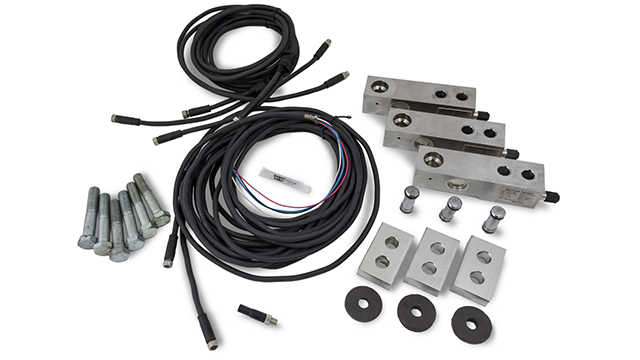
SLB615D POWERCELL® load cells provide extremely high accuracy up to OIML R60 C10 and NTEP 10000d III M which is three times better than typical. The internal microprocessor continuously compensates for environmental factors to provide the most accurate measurements and offers active condition monitoring of key parameters. The SLB615D load cell is optimal for any multi-load cell scale when accuracy and reliability are key.
Please describe your project. /content/gb/en/home/products/Industrial_Weighing_Solutions/load-cell-and-weigh-module/strain-gauge-beam-load-cells/powercell-load-cells.fb.1.c.11.html
Connectors and Cables
POWERCELL® load cells are easy to install, connecting to each other and the indicator in a simple daisy-chain network. Data transmission is via CAN Bus for a robust digital signal not affected by cable gauge and length, dampness, etc. No junction box is required, thus eliminating a common source of error. The load cells have M12 industrial cable connectors allowing the load cell or cable to be replaced independently without affecting system performance
Smart Diagnostics
Load cell failures very often go undetected in analog systems. With POWERCELL® load cells this cannot happen. The weight information from each load cell is handled separately for active condition monitoring by the indicator. Load cell overload or failure, out-of-symmetry errors, or out-of-range temperature signals are recognized immediately and corrective action initiated, often allowing the scale to operate until the load cell is replaced.
Hello, my name is Ferenc Muranyi. I'm product manager for weighing components at Mettler Toledo. Having confidence in your weighing system for your production batches is critical to ensure high quality products. Downtime is not an option. Right at first time, batches are a must in the chemical industry. Our PowerCell technology and the diagnostic functions help to avoid errors or inaccuracies which could potentially lead to poor product quality or, in the worst case, recalls and claims. Let me demonstrate the key functionalities of our PowerCell technology with this demo tank. At the bottom, we mounted traditional old school analog load cells. On the top, we mounted our PowerCell technology. You might ask, what are the key differences between analog systems and our PowerCell technology? There are many, but today I will cover the top five. The first four functions alert you about the following conditions: missing or failing load cell, out of range temperature, overload of a single load cell, and a symmetry error. If any of these events occur, we have the fifth function in our PowerCell technology, the RunFlat. That will make sure that your weighing system is running even in the case of error. Firstly, I will demonstrate how the system alerts you about a missing or malfunctioning load cell. Of course, we assume everything runs as intended, but remember, it takes only one failure to result in irreversible consequences of a production batch. In an analog system, the weighing terminal receives the sum of the signals coming from the load cells. Without any further information about the status of the scale, but in a power cell system, each load cell transmits the weighing result and the status information. In contrast to power cell system, in an analog system, the component failure is not apparent to the operator or to the control system, which could lead to out of spec results. Using power cell technology, this won't happen. Let me now demonstrate what happens when a load cell completely fails. To show that, I will cut the cable of an analog load cell and of a PowerCell load cell, and we will see how the system is affected. On the terminal's display, you see the analog weight value at the bottom and the PowerCell value on the top. Now I cut the analog cable. You see a significant change in the indicated weight. But you can't tell if this value is true or not. So a broken load cell goes completely undetected. Now I'm cutting the power cell cable, and you see a totally different result displayed on the terminal. In this case, the user and the control system are alarmed, and they can react before any real problems occur. Each power cell contains a temperature sensor which detects when the temperature is out of range. For example, if exceptionally hot material is in the tank or nearby, you are immediately alerted about potential measurement errors. Each power cell load cell also self-monitors to tell you when the load is too heavy or has a run-in with heavy equipment. This self-monitoring tells you about potential reduction in accuracy and in the worst case, damage of the load cell or components within the scale. PowerCell load cells constantly monitor themselves for internal defects, such as broken wires, leakage, and sufficient wattage supply. If anything is amiss, you will receive an alarm to prevent costly production errors. In a tank scale, the center of gravity typically stays in a small horizontal range and mostly shifts vertically with loading. Let's assume material slowly collects on one side, leading to negative consequences in your production. This collection of material shifts the center of gravity one side and is detected by the terminal as an error condition. The same would happen when a tank leg breaks, the foundation loosens, or a blockage develops. Thus, symmetry monitoring is a form of condition monitoring that lets you react before trouble gets there first. Again, this is not possible with an analog system. We have talked about the condition monitoring that the PowerCell-based system delivers. If you see a rare failure of a PowerCell scale, you have the option to stop production or use the automatic run-flat function. Similar to car tires, run-flat allows you to drive slowly until the tire can be replaced in the next repair shop. The terminal emulates the faulty load cell, so manufacturing can continue, with a lower accuracy of course. That ensures a smooth transition until the problem is solved. Now I cut the power cell load cell cable again, and then you see a much better outcome. The run flat function is activated, so the terminal continues weighing, including a clear status indication that it is in a less accurate state. Again, this safety feature is not available in analog systems. All the PowerCell functions help to avoid undetected failures that lead to production problems and even to product recalls. So when quality is important and uptime is important, consider our PowerMount weigh modules with the built-in PowerCell technology. And now, the clear winner is PowerCell.
Weightless System Calibration with CalFree™ Plus
Every POWERCELL® load cell is equipped with an onboard microprocessor, and as part of the manufacturing process, the load cell's calibration data is stored in its memory. When the system is hooked up, the calibration data is transferred without error to the indicator, and the scale can be calibrated in seconds by CalFree Plus. In the unlikely event of a load cell failure, the calibration data for the replacement load cell is read and the scale can be recalibrated easily by CalFree Plus.