The effects of carbon dioxide on alkaline titrants
Why am I observing two inflection points adjacent to each other during the acid - base titration?
Possible reasons:
The caustic (basic) titrant is contaminated with carbonate due to the uptake of carbon dioxide from the ambient atmosphere. The titrant thus contains both carbonate and hydroxide ions, i.e. two different basic substances that react with the acidic sample solution. If such contaminated titrants are used to titrate strong acids, a typical “carbonate titration curve” results that shows two adjacent inflection points.
Another possible reason might be that the sensor condition is bad, which requires sensor maintenance actions.
Recommendations:
Carbon dioxide has severe effects on titration using alkaline titrants.
CO2 reacts with strong bases such as NaOH, KOH, TBAH, NH4OH resulting in carbonates according to the following equations:
H2O + CO2 -> H2CO3
H2CO3 + 2MOH -> 2Na2CO3 + 2H2O. (M = Na+, K+, NH4+,TBA+)
The titrant thus contains both carbonate and hydroxide ions. If this is used to titrate strong acids, then there is a typical “carbonate titration curve” with two inflection points [Figure 1].
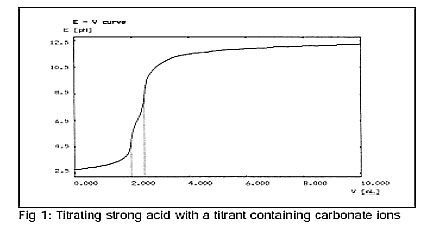
The identification of the two jumps is not so simple as the excess titrant and ratio of the equilibrium point change during the titration. The first jump may correspond both to the strong acid and to the transition of carbonic acid to hydrogen carbonate. The second jump may be the transition from hydrogen carbonate to carbonate. If weak acids are titrated only one jump is observed. This means that all concurring reactions occur simultaneously, discrimination between the inflection points is not possible. As strong bases are usually titrated with weak acids (potassium hydrogen phthalate, benzoic acid), the concentration of the titrant used for the analysis of strong acids is not correct and will produce false results. Thus, alkaline titrants should be made up and protected to minimize the effects of CO2.
- Preparing CO2-free basic titrant solutions
The optimal way to achieve CO2-free titrant solutions is to purchase the respective titrant in the required concentration in sealed containers. If the titrant solutions shall be prepared, it is highly recommendable to use titrant concentrates that are commercially available as ampoules. The concentrate needs to be diluted with CO2-free, deionized water to a specific volume, usually 1 L. Degassing of the deionized water source by nitrogen purging together with ultrasonic irradiation is an effective measure to exclude CO2. - Caustic titrant storage
An effective measure to avoid CO2 uptake of caustic titrants in use is to use solid CO2 absorbing agents that are filled into tubes which are mounted on top of the titrant bottle. A recommended absorbing agent is ascarite®. Ascarite® contains NaOH to act as a CO2 scrubber as well as a drying agent to keep the NaOH from adsorbing water and eventually leaking concentrated caustic into your titrant. Ascarite® can similarly be replaced with NaOH pellets protected from water by having a layer of glass wool above and below it in a drying tube with a drying agent such as molecular sieve or silica gel on either side to protect it from absorbing too much water. With either solution, one should frequently change the material to avoid saturation and titrant contamination.
Legal Information
Ascarite is a registered trademark of Arthur H. Thomas Co.
© METTLER TOLEDO. All rights reserved.