
Spectrophotometers for DNA Analysis
Determine the Concentration or Purity of DNA, RNA, and Protein in Seconds

Advantages of DNA Measurements

DNA, RNA and Protein Analysis
Pedestal and cuvette measurements are combined in one compact instrument. With only 1–2µl of sample, the concentration or purity of DNA, RNA and protein can be checked within seconds. Also find pre-programmed methods for A280, A260, 260/280 ratio, etc.
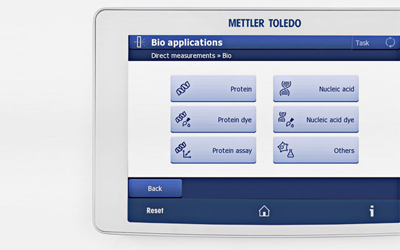
Predefined Bio-Applications
The One Click™ user interface includes many predefined applications for the analysis of bio-molecules. Nucleic acids, like dsDNA, ssDNA or RNA or can be easily tested for purity or concentration.
Find out More About Our UV/Vis Spectrophotometer Lines

UV/VIS Excellence Spectrophotometer
Discover spectroscopy with METTLER TOLEDO's Excellence UV/VIS cuvette and micro-volume spectrophotometers. Take your research to the next level. Order now and experience the difference!

EasyPlus UV/VIS Spectrophotometer
EasyPlus UV/VIS spectrophotometers offer 3-in-1 functionality: conventional spectrophotometry, color measurements, and water analyses. Let's effortlessly ease up your routine spectroscopic workflows.

Useful Related Links

UV Vis Accessories
Optimize your spectroscopic workflow using our smart accessories, such as a cuvette changer, autosampler, thermostat, etc.

UV/Vis Spectroscopy in Bio Applications
Discover how UV5Bio and UV5Nano Excellence spectrophotometers deliver accurate micro-volume measurements for nucleic acids, proteins, and cell culture applications in your lab.

LabX Software for UV Vis
LabX™ PC software is used with our UV Vis instrument to support data integrity compliance with FDA 21 CFR Part 11

UV Vis Autosampler
Choose between the Flex, Pro, and Max UV Vis InMotion™ autosampler base, and combine it with a sample rack. Finish your system with a UV Vis sample kit to make it the perfect fit for your laboratory.

UV Vis Cuvettes
The METTLER TOLEDO cuvette portfolio offers reliable and economic macro glass cuvettes in 10 and 50 mm optical path length (OPL), Micro Cuvettes and Flow Cells.

UV Vis Publications
Find our publications in the topics of UV Vis spectrophotometric fundamental, applications, instrumentation, pharmacopeia compliance, etc.
Unlock Service Excellence - Maximize Your Efficiency

FAQ
Can a DNA spectrophotometer be used to measure RNA concentration?
How do you measure DNA concentration using a spectrophotometer?
What is the optimal wavelength for measuring DNA absorbance?
What is DNA quantification?
Why is DNA absorbance at 260 nm?
What is the A260/A280 ratio, and what does it indicate?
How can I improve DNA quality with a low 260/230 ratio?
- Automated UV/Vis Spectrophotometer Calibration
- Color Spectrophotometers
- Microvolume Spectrophotometer
- Single-Beam Spectrophotometers
- Spectrometers for Chemical Analysis
- Spectrophotometer for Pharma
- Spectrophotometer UV Vis
- Spectrophotometers for Water Analysis
- UV Spectrometers
- UV/VIS Autosampler
- UV/Vis Cuvettes for Spectrophotometers
- UV/Vis Spectrophotometer
- UV/Vis Spectrophotometer Accessories