 |
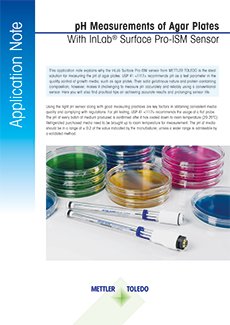
To learn more about measuring the pH in agar media download this free application note. |
Every step, in agar media preparation is vital for creating an optimal environment for culture growth. One of the most important aspects is accurately measuring pH, as it can significantly affect the media. Despite its importance, measuring the pH of agar media is challenging when using routine pH sensors. When a sensor with a spherical pH sensing membrane is used, the flat surface and solid gelatinous nature of agar plates result in inadequate contact between the sample and the sensor, leading to improper interaction with the reference electrolyte. Consequently, this and some other factors represent major limitations of traditional sensors, leading to fluctuating readings and unwanted downtime. Such challenges could be overcome by using a specialized sensor and meticulous care during measurement.
METTLER TOLEDO's InLab™ Surface Pro-ISM is especially designed with a low resistance glass membrane that ensures improved accuracy and accelerates response times. It has a flat pH sensing membrane, which enables the junction to maintain full contact with the samples like agar media. Additionally, the sensor includes an open ceramic ring junction that facilitates a faster outflow of the reference electrolyte, thus reducing the measurement delay.
This application note delves into detailed aspects of measuring the pH of agar, addressing the challenges you may face along the way. It recommends the perfect sensor for your measurements and provides helpful tips to ensure you achieve consistent and accurate results. Download it now and enhance your agar plates’ performance.
Watch our video to learn how METTLER TOLEDO sensors ensure accurate pH measurements for optimal culture growth!
pH Measurement of Culture Media. Culture media is a complex matrix that supports the growth and survival of microorganisms. In addition to right nutritional composition, a correct and stable pH is a key to optimum microbial growth in culture media. Growth media can be solid, semi-solid or liquid in nature. The different forms of media present different challenges. pH measurement of solid media is difficult with conventional sensor due to its spherical shape. Since the reference junction is not in contact with the sample, it leads to inaccurate or unstable results. The ceramic junction of pH electrode can be clogged due to complex sample matrix of liquid media. In conventional pH electrode there are free silver ions in the reference system that can leach into the sample and give unstable readings. They could also react with proteins from the sample and precipitate resulting in clogging of the reference junction. The Mettler Toledo solutions to these challenges are specialist sensors like in-lab surface pro is m for solid media and in-lab max pro is m for liquid media The InLab Surface Probe ISM with a flat pH membrane of low resistance LOT glass and ceramic ring junction is ideal for measuring flat surfaces like auger plates. This junction provides fast outflow of electrolyte to enhance response time. The polysulfone shaft ensures good chemical and mechanical resistance. Inlab Max Pro ISM has an immovable glass sleeve junction, which is easy to clean and ensures steady outflow of the electrolyte, enhancing the response time for the measurement in liquid media. The pH-sensitive H.A. glass membrane is extremely robust and ensures reliable results in alkaline media samples. Both sensors have argentthal reference system which consists of AgCl granulated filled cartridge. The silver ion trap arrests the discharge of silver ions into the electrolyte solution and thus prevents the precipitation with proteins in the sample. This gives stable and fast results. The built-in temperature probe, together with automatic temperature compensation functionality of METTLER TOLEDO pH meters, compensates the temperature effects by measuring sample temperature accurately. These sensors have an intelligent sensor management, or ISM, technology that offers data security by storing calibration history and critical sensor information. Select the suitable electrode and calibrate it with pH buffer solutions from Mettler Toledo. Use the buffers to bracket the sample pH range. Gentle stirring the calibration solutions or samples with the U-mix magnetic stirrer ensures homogeneity and quick response. For sample measurement using InLab Surface Pro ISM, take the agar plate and simply touch the sensor tip to the media. Measure the pH of the samples. Take aliquots of the liquid media samples in a clean beaker so as to ensure that the junction is well immersed into the sample. Here are some tips and hints to ensure quick and accurate results. For thorough cleaning of the sample residues from the electrode membrane after the measurement, clean it with deionized water. Use mild soapy water or ethanol if required. After cleaning with ethanol, recondition the sensor in storage solution for two minutes. Do not rub the sensor surface. Always blot dry with tissue paper to remove any excess water. Soak the electrode in Pepsin HCL solution for one hour once in a week to remove Move protein buildup on glass membrane. Since the regular maintenance improves the life of the electrode, periodic reconditioning of the electrode is recommended. Store the electrode in in-lab storage solution when not in use. The pH range for in-lab surface pro ISM is 1 to 11 pH units and hence it should not be exposed to harsh acidic or alkaline chemicals. So, with solutions from Mettler Toledo, measuring pH of media samples is no longer a difficult task. Ensure maximum accuracy choosing the right sensor for your application.
The following sections highlight more details about agar as a nutrient media and discuss the importance of measuring its pH.
Why is it important to measure the pH of agar media?
Stable pH is vital for optimum microbial development and growth in culture media. The ideal pH of a culture medium provides a favorable H+ ion concentration suitable for the growth of microorganisms.
pH significantly affects the enzymes present within these microorganisms. When the pH is altered, it can lead to the denaturation of enzymes, changing their structure and disrupting their catalytic properties. This alteration also affects the ionic charges on the enzyme molecules, impeding their ability to bind with substrates and facilitate essential biochemical reactions. The disruption of metabolic processes can lead to reduced cell division, slower growth rates, or even cell death, highlighting the importance of maintaining an appropriate pH for optimal bacterial activity on agar media plates.
When should the pH of agar media be adjusted during preparation?
The pH of the media should be adjusted during preparation if it falls outside the desired range for the specific application. Adjustments should be made by adding diluted acid or base before sterilization to ensure accurate pH levels are maintained during the entire experimental process. Regular monitoring of pH may also be necessary during long-term use to ensure it remains within the optimal range.
What is the optimum pH for growing the microorganisms?
Most bacteria grow at a pH range of 6.5 to 7.0, which is near neutral. However, some bacteria are capable of surviving in highly acidic environments with pH levels as low as 1.0, while others prefer alkaline conditions, growing optimally at pH values between 8 and 10.5. Each microorganism has a specific optimum growth pH at which it flourishes best. If the pH falls below the minimum growth threshold or exceeds the maximum growth threshold, microbial growth can occur very slowly or may not happen at all.
Which factors can influence the pH of agar media?
The pH of agar plates can be influenced by a variety of factors that can lead to unstable readings. Key contributors include the type and concentration of agar, as well as the medium's composition and the presence of buffering agents. Water quality is essential, as inadequate or unsuitable water can affect pH. Contamination from containers, excessive sterilization, improper mixing, repeated re-melting, and unsuitable storage conditions can also result in pH variations. Additionally, agar plates are temperature-sensitive; they should be measured at room temperature. Finally, the age of the plates and the quality and calibration of the pH electrode can significantly impact measurement accuracy, highlighting the importance of proper handling and monitoring techniques in laboratory environments.
To learn more about the importance of pH measurements in agar media, the advantages of using the right sensor, and good measuring practices, download our application note by clicking on the button above